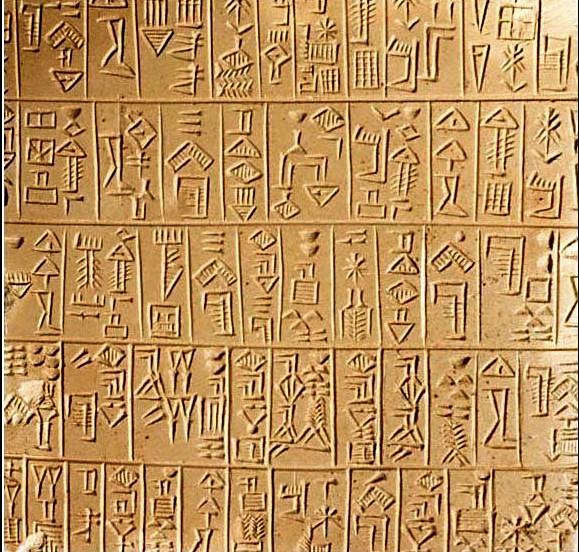
SumerianWhat is Sumerian?Sumerian (emegi in its own vocabulary) is the world's oldest written language, spoken over 4.000 years ago in lower Mesopotamia. It is an unique language in the sense that it doesn't seem to be structurally related to any other known language.Sumerian was always in contact with Akkadian, the language of upper Mesopotamia. Both languages took loanwords of each other, and when Sumerian died out as a spoken everyday language, it was preserved by the Akkadian-speaking population as a high tongue for ceeremonial use. The writing system originally used stylized pictures of various things impressed by a stylus into clay, so-called logograms. Over time, the script evolved and became more abstract, developed the ability to write the sounds of words syllabically and invented logograms for words that cannot be depicted. Eventually it became so useful that even after Sumerian was no longer spoken, cuneiform signs were still used to record texts in various other languages. In fact, cuneiform was considered useful for nearly 2000 years. Most of the iconic elegant-looking cuneiform writing is actually not Sumerian - Sumerian cuneiform typically less elegant, resembles more a collection of abstract drawings and often even lacks the characteristic wedge-shape of the sytlus imprint:
What is known about Sumerian?Quite a lot, actually. The standard academic dictionary ePSD2 contains over 16.000 entries. There are many known texts, ranging from the rather prosaic language of delivery receipts and legal decisions via hymns, proverb collections and praise poetry to relatively long historical and mythological texts, the best known of which is probably Gilgamesh.Scholars generally agree on what these text mean, but there are bits and pieces which are hard to translate and where the meaning is debated. A much harder question is how to pronounce Sumerian correctly and what the reading of individual cuneiform signs is supposed to be. The situation that the meaning of a word is clear, but how to say it is not is fairly common. Here, several schools of thought exist and different academic resources do not always agree. Similar debates concern the grammar when trying to understand the details - the translation of an expression can be quite clear while the different morphemes that underly that form and their precise meaning may not be obvious at all. Finally, there are definitely stylistic nuances in expressions that we do not understand and hence cannot properly translate. Why (and how) learn Sumerian?Some people may find it exciting to be able to read inscriptions on artifacts displayed in a museum (or widely available as photohraphs e.g. on Wikipedia). Since many of these inscriptions are dedications, they use a limited set of stock phrases, and so learning to decipher them is relatively easy.More ambitious-minded people might be fascinated by the window into the thoughts and ideas of people 4000 years ago and delight at reading the odd metaphor or unusual mental picture behind an expression which we find chielfy in longer prose texts. Learning to read prose - especially in the original cuneiform - is not such an easy task as it requires to memorize a lot of vocabulary and signs as well as a good amount of reading practice. Ultimately, you have to decide what your own reasons are and what level of insight you're aiming for. The standard path to Sumerian in the past has been to study Assyriology and then learn Sumerian after you've mastered Akkadian. For that reason many academic resources actually assume that you're familiar with Akkadian and can read Akkadian text in cuneiform. Also, academic texts usually like to use original text - there is a nice introduction to Sumerian in Royal Inscriptions increasing in difficulty by Hayes for instance. In addition, academic texts tend to discuss all the fine print of interpretation. This however is not how we usually teach languages. If you're working through a Finnish course, you will not see texts taken only from obituaries of the last 150 years, neither will you have to learn the rules of how phonemes interact to form Finnish phonology. Instead, you'll get a series of intentionally simplified texts that do not represent everyday Finnish but help you learn and understand an idealized Finnish piece by piece - and only once you've mastered that, you will have to tackle the differences of the everyday language to that idealized version. And in fact, that is precisely how I was taught Latin or Greek at school - first came idealized texts, then Plato or Homer and how they differ from the simplified ideal. Why not try to teach Sumerian that way?
The courseEmegi mu-ub-e-en is an attempt to provide a modern intermediate-level introduction to Sumerian that aims to enable the reader to use Sumerian as a language, i.e. to read and speak (or, given the uncertainty in pronounciation, perhaps rather write) it. The course introduces Sumerian grammar, vocabulary as well as cuneiform script along with exercises and conversation sections.Currently the text is in an alpha-stage. It has not been properly proof-read and contains all errors that slipped by me. If you're interested at this stage, please report any oddities, mistakes and inconsistencies so that the text can be improved in future versions. Useful online resourcesFor anyone who wishes to delve deeper into Sumerian, I found the following tools very useful:
Back to main index Created by Thorsten Renk 2026 - see the disclaimer, privacy statement and contact information. |