Tactical Principles of the Meyer SystemThe principles which Meyer bases the tactics of his longsword system on are fairly easy to grasp, because in his book Gründtliche Beschreibung der Kunst des Fechtens he lays them out in a logical order.The system is heavily based on Liechtenauer's system and one recognizes many common features, yet the emphasis is subtly different: While Liechtenauer for the most part appears to envision short exchanges that can quickly be fought to a decisive hit and the advice to wind your sword to the next opening which you can reach is more of a fallback plan in case the actual opening moves were not yet decisive, for Meyer hits mainly emerge from situations in which quick attacks from one opening to the next are done and the opening moves are more of a way to get safely into an attack series. In Meyer's own words: In the beginning need cuts from the guards to attack and pressure your opponent, and when you have attacked and perhaps also have come underneath his sword, you need different techniques to finish the action - namely the work of the hands - so that you can push strongly to all of his four openings so that he may not threaten you(1) Of course there is a crucial difference in fencing style which - at least partially - accounts for this shift of emphasis: Thrusts are no longer valid attacks at Meyer's time. There is a substantial difference between fencing today and in the times of our ancestors. I will only describe fencing today and this means cuts with the blade, but the old use also involves cuts and thrusts in sharp fencing, which I will deal with in a different place.(2) Counter-thrusts, in the form of Absetzen, are a fairly powerful spoiler against bold attacks because they can be done very fast. Likewise, thrusts are fairly well-suited for follow-up attacks when an attack has been blocked and a temporary bind is reached because the sword doesn't have to be pulled back as for a cut. Thirdly, thrusts provide good threats for feinting. Removing thrusts from fencing thus also removes some of the speed - extra time is needed to pull back the sword for a new cut, and so it becomes more difficult to seek a decisive hit within the first few actions. Presumably this accounts for the shift in emphasis from Liechtenauer to Meyer.
Overwhelm the opponent with quick attacks from one opening to the otherWhen introducing cuts, Meyer presents the figure known as Meyer's Square which shows the lines of possible cuts:
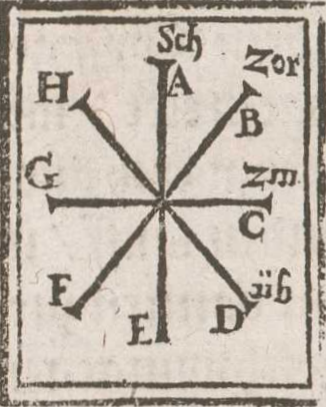
This sequence can be done fairly rapidly and moreover matches with a natural right, left, right, left step pattern to advance. Meyer emphasizes that this is a very important aspect of fencing: Every cut needs to be done with a matching step, and they need to be done together if you want to achieve something with your techniques. If you step too early or to late, your technique is poor and you waste your cuts.(3)
Use feints or cut short if the opponent tries to blockWhile the sequence of quick cuts along different lines can overwhelm a beginner, an experienced fencer is usually capable of fending it off quite comfortably. To pile more pressure onto the defender, Meyer recommends to watch the opponent and if he merely tries to block the attack, pull the cut short or onto a different line to avoid blade contact.This is the practice of cunning, and it teaches you that if you are aware that your attack is in vain at one opening, you should quickly move your sword away before the blades even make contact, or pull short and then attack a different opening, and if he wants to block there, pull that short as well and move quickly from opening to opening till you manage to hit.(4) The important thing here is to observe and react to what the opponent is doing, because such feints only work if he is trying to block - if he is counter-attacking, moving the sword away from the incoming cut is an invitation to be hit.
Make a blade contact and bind if the opponent tries a counter-cutMeyer spells this out quite clearly:If you cut to an upper opening and you realize that he doesn't cut but merely moves his sword, so don't let your own cut make contact but attack a lower opening, but if he cuts against you, cut with your own attack against the strong of his blade(5) This means that the opponent must be observed even during the attack: If you cut left, you should also study the opening right, and you should watch while you rush toward the opening you have spotted what techniques are employed against you, so that you should not take damage from attacking an opening too eagerly (6)
In a bind, you can wind the blade to attack or use other means to followWinden (winding) in the context of Meyer's system is a bit different from what it means in the Liechtenauer Zettels - Meyer defines it as cuts which are done around a pivot point that is the contact with the opponent's blade. In such attacks, a fencer has a measure of control over what the opponent is doing and - most importantly - the opponent cannot simply release the bind without getting hit.If you bind from your right to your opponent's sword, so stay firm in the bind and wind the top of your blade inwards against his head, and back again(7) Just like for the attack series with cuts before, a bind offers four openings to wind a blade around - high and low, left and right. So the idea once a bind is established is that the attacker just continues to quickly attack around the contact point, searching for an opening. Should the opponent leave the bind, it is always possible to try a slice to the arms or wrists. If he defends well staying in the bind, simply pushing the opponent away with the cross-guard might provide an opening: But if he recovers and cuts against you, be ready with a cut against his blade. If he leaves from your blade then silce his arm, if he stays in the bind then push him away, quickly cut towards an opening and go back to his sword.
Zufechten should be used to create a good window to attackA crucial point in the system is the first attack, as it may run into a single-tempo counter-cut and thus be dead on arrival. Meyer advocates the use of the Zufechten phase to create an opportunity for an attack, for he is firmly in the camp of those that advocate that it is good to have initiative:See to it that you're the first to take action, before he finds his guard, attack!(9) Well, in fact you are encouraged to really pressure the opponent from the beginning: If you manage to attack boldly and quickly, you force him to let you do your other work relatively unopposed, once he tries to work against that, you can continue to push him with Nachreisen, slices, shoves and similar, so that he may not ever find the time to counter you.(10) Guards for Meyer are not really positions to assume but really transient end points of a motion (reminiscent of the Fiore concept of posta instabile and pulsativa). As far as the guards are concerned, I don't want that one remains long in one of them(11) The reason for this is, that he believes just standing in a guard makes one too predictable (and being predictable means any attack is likely to be countered successfully): It is always better one doesn't commit to a guard, since from the guard the opponent can deduce what technique you are going to fence later (12). What Meyer then argues is that by constantly changing guards, one forces the opponent to do the same and so creates oppoetunities to attack the opening which a moment ago was covered by the sword (Nachreisen). In the fencing manual, frequently advice like move your blade up three times and then attack with an Unterhau can be read, indicating that indeed the Meyer system favours a large variety of motions, deceptions and feint attacks before the actual attack commences.
Liechtenauer provides many useful sequences to attackMeyer doesn't spell this out, one actually has to compare sequences he recommends to initiate action from a particular guard with what is found in the Liechtenauer Zettels. To attack an opponent who is in a high guard, Meyer utilizes the concept of the master cuts as attacks which block the line for counter-attacks in the following recommended sequence: Zwerchhau right, then left, then right as a feint, Zirkelhau right, Scheitelhau and finished by Kreuzhau.Certainly the mechanism that keeps the attacker safe against a single tempo counter is the initial master-cut (elsewhere Meyer tells us that no cut is as safe as the Zwerchhau in Zufechten) the attack is then developed from the initial cut according to what can be done quickly and keeps adding pressure. In a similar way, Meyer describes attacks against low guards with sequences that start out with ideas from Liechtenauer and then smoothly continue to the chained sequences of quick attacks that are typical for Meyer.
When defending, try to cut against the bladeFor a system based on having initiative and constantly pressuring the opponent, being on the defense is anything but desirable. However, as for Liechtenauer, it is quite acceptable to let the opponent have the first attack, but end it quickly with a cut against the blade, followed by a change of initiative and a counter-attack series. For instance, Meyer recommends to a fencer staying in Zornhut to deal with the following sequence with an attack coming from above: A hard Mittelhau to the blade, let the blade bounce and continue with Zwerchhau left and right. Certainly the idea is similar to the Zornhau response to a high attack from Liechtenauer where the quick thrust following the Zornhau is replaced by a quick succession of Zwerchhau described elsewhere.So in a way, Meyer utilizes the same two possibilities Liechtenauer uses to avoid double hits in starting a sequence: either you let the opponent do the initial attack and defend in a way that allows to seize the initiative, or you attack in a way that the obvious line for a counter-attack is closed.
Blocking is a good tactic to gain timeLiechtenauer takes a dim view on blocking attacks and the Zettels flat out say one shouldn't do it 'as the common fencers do'. Meyer is less critical:With which he [Liechtenauer] didn't want to prohibit blocking so that you'd learn nothing but cutting - that would be your loss. (...) It is no use to cut over-eagerly, and you should also not without any observation cut into his attacks - this wouldn't be fencing but just the brawling of a peasant.(13) In essence, Meyer seems to say that it is better to block attacks (because that is simple to do) to gain the time to obsverve and plan and then act rather than to cut into the attacks without taking the time to observe and plan. Given that a block can be done much faster than a cut, there is certainly something to be said for that. Ultimately, Meyer identifies some windows for a counter-attack even if a fencer is currently defending, for instance if the opponent raises the hands too much for an attack from above, the idea would be to fall upon the wrists to slice, or if the opponent cuts short, to simply step away, let the attack miss and counter.
Durchwechseln is the technique to counter attacks against the bladeOne very useful defense against short cuts (both Schiel- and Krumphau which are shorter than true-edge cuts by the nature of their grip as well as cuts that are intended to the blade) is Durchwechseln, i.e. to let the opponent's blade miss by quickly lowering and raising the tip of the sword.Whoever is experienced in fencing and knows how to use Durchwechseln, for him it is artful work and should be use against those who cut more to the sword than to the body Durchwechseln creates an opportunity for an attack because the opponent needs a split second to get his own blade under control again - after all, he expected to make a contact that would stop the blade, but now he has to do it himself. Obviously there is an interesting tension between the need to seize initiative by strong cuts to the blade - which is balanced by the risk that the opponent might forsee just that and counter with Durchwechseln.
Use initial feints carefullyWhile Meyer advises to use feints as part of attack sequences later in an exchange, he is comparatively reluctant to use them to initiate the exchange and not many such sequences are described in the manual.One feint utilizes a Zornhau (diagonal cut from above) pulled short to that the blocking blade never makes contact. Liechtenauer follows this with a thrust, Meyer replaces the thrust with a right Zwerchhau, but the general idea is the same - the feint, if successful, removes the opponent's blade from the likely line of counter-attack. Curiously enough, Meyer also describes a triple-feint which starts out as a Zornhau which is then changed to a Schielhau and if the opponent attempts to parry that, changed again to a left Zwerchhau around the parry. Presumably this is not an easy sequence to execute with the corrent timing to make it work as a feint and - at least partially - may be meant as a play in Zufechten. Plan a retreatIt is difficult to keep attacking while maintaining correct structure and footwork at all times - small mistakes will accumulate and eventually make the attack series fail. Meyer acknowledges that by advising that you should plan a retreat at some point:It should be noted that after any exchange you have fought you need to retreat, either before the opponent or after him or together with him. If you want to retreat before him, try to pressure him so that his hands come up for protection, if he then wants to see what you're going to do, so cut hard together with your retreat and be away before he realizes what is happening.(15) Of course, the retreat of the opponent allows attacks of opportunity if the right moment can be spotted in time. SummaryMeyer's fencing manual certainly presents a detailed and sophisticated continutation of the Liechtenauer system and utilizes similar techniques to make sure a reckless or incompetent opponent is not easily able to hit a careful fencer.Meyer views an exchange as composed of four different phases. The first is Zufechten where the fencers change guards freuqently while at the same time they try to spot suitable openings for attacks. This is followed by the initial attack - this needs to be done carefully to avoid running into single-tempo counter cuts. Here many of Liechtenauer's sequences are used and developed further. Once the initial attack is done, the idea is that rapid follow-up attacks leave an opponent no time for more than hasty blocks, so the follow-up attacks are fairly simple cuts and feints which change the line of attack. Finally a retrat, covered by a vigorous cut, needs to be made. For defense, the system rather relies on blocking till a suitable opportunity to counter with a hard cut arises, but from the description of the techniques and sequences as well as Meyer's tactical advices, it is fairly clear that Meyer doesn't believe one should defend for any extended period of time if that can be avoided - the idea is to be on the attack at all times. Short of thrusts (which are not done), the large variation of sequences that are spelled out in detail is fairly interesting to note and adapt to modern fencing.
Original quotes (English translations above by myself): (1) so mustu im zugang durch die Leger erstlich etlich häuw brauchen, mit welchen du dein gegenpart am besten vermeinest anzugreiffen und zu ubereilen, und wenn du denn im ersten theil angriffen und zu ihm, oder villeicht under sein Schwerdt kommen bist, so mustu ferner noch mehr stück haben, damit das gantze stuck vollendt werde, welches du denn aus dem andern theil diß Buchs lernest, nemlich der Handtarbeit, auff das du ihn ferner zu allen vier Blössen tringest, unnd er dir zu keiner schädlichen arbeit kommen möge (2) Dieweil zwischen dem Schwerdt Fechten zu unsern zeiten, wie bey unsern vornfahren und uralten im gebrauch gewesen, ein grosser underscheid, das ich an diesem ort nur was jetzund gebräuchlich unnd so viel zum Schwerdt gehörig von häuwen erzelen, so vil der alten gebrauch aber belangt, wie sie beide mit Hauwen unnd stechen scharpff gefochten, wil ich in seinem gewissen unnd sondern ort anzeigen. (3) Derwegen ein jeder streich sein eigen Trit muß haben, welcher zugleich mit dem streich soll geschehen, wiltu anderst etwas mit deinen stucken welcher du dich gebrauchest ausrichten, denn Trittestu zu frü oder zu spat, so ist es umb dein stuck geschehen, und bringest dich also selbst umb deine Häuw> (4) das ist die Practick genant, welches ist der list, und lehrt dich wie du dein Häuw wo du gewahr wirst, das solche an einem ort vergeblich oder unfruchtbar seind, bald unnd behendig von dannen ehe dann solcher Hauw antrifft wider abzuckest, oder fehl füruber gehn lassest, und den einer andern Blöß zuführest, wil er daselbst auch versetzen, so zuck daselbst auch ab, und laß also verfliegen von einer Blös zur andern, so lang unnd vil biß du eine ereilen kanst zu treffen (5) Nemlich wann du ihm also ein haw zur obern Blösse führest, und merckest das er nicht hauwet, sonder deinem Schwerdt entgegen fehrt, das du als dann dein hauw nicht antreffen lassest, sonder dein klingen der undern Blöß zuführest, wo er aber under des hauwen wirt, so fahr mit deinem Hauw fürt doch gegen der sterck seiner klingen (6) als wann du erstlich in dem du zur Lincken schlechst, zum andern auch zugleich mit zur Rechten die Blös sehest, Denn zum dritten eben so wol warnemest so du der ersehenen Blöß zueiles, wo oder mit was stucken man dir zukommen möge, auff das du dich nicht an deines widerparts Blösse vergreiffest, und des schaden nemest (7) wann du von deiner Rechten an deines widerparts Schwerdt gegen seiner Lincken hast angebunden, so bleib am Bandt fest, und wende ihm das vordertheil deiner klingen einwerdts gegen seinem Kopff, unnd wider heraus (8) erholt er sich aber und hauwet auff dich her, so sey du mit dem absatz oder Schnit wider da, und fall ihm gegen seinem streich an die kling, gehet er wider von der klingen ab, so schneidestu ihm wider auff die arm, bleibt er aber an deinem Schwerdt, so stoß ihm sein Schwerdt mit deinem schildt beyseits aus, und laß dein Schwerdt behendt wider der nechsten Blös zufliegen, und von dannen behendt wider an sein Schwerdt (9) Shauw das der erst seist auff dem Blan, Ehe er sich Legert greiff ihn an. (10) So du sie ihm Vor gewaltig und behend volbringest, zwingest du ihn das er dir andere arbeit ohn sein danck auch zulassen mus, dann ob er schon dargegen zufechten sich arbeitet, so bistu ihm doch schon auff dem hals, mit nachreisen, schneiden, trucken und dergleichen nach zufolgen, damit du ihn zu keiner volkommenen arbeit kommen lassest (11) SO vil nun aber die Leger belanget, so wil ich nicht das mann in deren einem lang verharre (12) das allweg besser sey es Leger sich einer gar nit, sintemal aus den Legern leichtlich dein gegenmann kan abnehmen, was für stuck du zufechten im sinn habest (13) Mit welchem er das versetzen darumb nit gar wil verbieten, nemlich das du nichts anders dann zuhauwen lehren solt, dann wie es dein schad, (...) Also ist es nicht nutz so du mit streichen uberbolderst, gleichfals auch hingegen unbedacht gleichsam mit zugethanen augen hinwider mit seinen streichen zuglich hinein Hauwen woltest, welches dann keinem Fechten, sonder vil mehr einem unbesunnenen Bawren getrösch gleichförmig. (14) wer aber im Fechten erfahren, und sich des Wechseln weiß zugebrauchen, dem ist es ein künstliche arbeit, und gehört gegen diese zu Fechten, die nur nach dem Schwerdt und nit nach dem leib arbeiten (15) Da dann sonderlich wol zumercken, das du nach einem jeglichen gefochtenen sinck auff dise drey weis immer must abziehen, entweders zu ersten vor dem gegenman, oder zu letzt nach ihm, oder anch zugleich mit ihm. Wiltu vor ihm Abziehen so befleiß dich, das du ihn zuvor mit stucken der massen engstigest und auff treibest, das er müß in die höch zur beschützung fahren, in dem er dann wil ersehen was du ferner arbeiten wöllest, so streich als bald mit dem abzug Hauw durch, und fahr hinweg ehe und dann ers gewahr wirt. Meyers manual on Wiktenauer
Back to main index Back to Swordfighting Created by Thorsten Renk 2025 - see the disclaimer, privacy statement and contact information. |