How to read the Walpurgis-FechtbuchThe Liber de Arte Dimicatoria (Book of the Art of Fencing), also known as the I.33 or the Walpurgis-Fechtbuch is dated to around 1300 which makes it the oldest known surviving manual of European martial arts. It describes the use of sword and buckler in unarmoured fencing and has a certain reputation for being obscure and difficult to interpret.Part of this certainly stems from the fact that the original is written in Latin and thus many people interested in historical fencing likely have to rely on a translation. However, a translation made by someone not experienced in medieval swordsmanship is bound to be misleading as the translator has no real idea what the author is trying to explain, conversely a translation made by a practitioner of medieval swordsmanship is bound to be influenced by his particular interpretation of the techniques. The aim of this article is to illustrate what issues and decisions a translation faces as well as what can reasonably be inferred from the illustrations and what not and thus to lay the groundwork for other articles dealing with the fencing system outlined in the Walpurgis-Fechtbuch. Images of the I.33 manuscript are used here under the Royal Armouries Non-Commercial Licence on the grounds that this article constitutes non-commercial research work into historical swordsmanship. In the following, page references are indexed following the I.33 manuscript scans, 5v means page 5 verso, 19r refers to page 19 recto etc. The SettingThe manuscript teaches fighting with sword and buckler using two main characters, 'the priest' (sacerdos) Ludger (named on 1v as clerus lutegerus - 'the cleric Ludger') and 'the scholar' (scolaris) Walpurgis (named on 32v) for demonstration. The text implies that Ludger is teaching Walpurgis, although one could not readily guess this from the illustrations, here Walpurgis is shown quite often to execute the decisive counter or winning technique.There is no clear scheme where each fencer stands, sometimes Walpurgis is to the left, sometimes Ludger (we may at times interpret that as a movement of the point of view to provide a different perspective on the action). The manuscript does not outline any theory of fencing, it just lays out different sequences, roughly sorted by the seven guards that serve as entry points and are discussed in the beginning. Usually, variant sequences with different options for counters appear and the reader is left to distill the general principles for himself. In that, the Walpurgis-Fechtbuch is fairly typical - what we'd recognize as solid presentation of fencing theory will have to wait till Joachim Meyer's work much later. Almost certainly the author assumes that the reader is familiar with fencing with sword and buckler. Several different point support this:
LanguageThe language of the Walpurgis-Fechtbuch is Latin with a few technical terms in German interspersed. The manuscript is partially damaged and so not all letters can be made out clearly, but the wording can be reconstructed with reasonable confidence.Clearly the scribe has made errors now and then (or rather the scribes, the handwriting indicates several) and corrected some of them subsequently, for instance on 32v sacerdos 'the priest' has been crossed out and replaced by Walpurgis, 2v has sinistra 'left' replaced by dextra 'right'. It is conceivable that the rare instances in which possessio appears instead of the expected obsessio (the translation of which to be discussed later) represents slips to the more common word rather than intent. True to the lack of orthographic conventions, there is some variation in the spelling of various words, moderately so Latin - e.g. nichil for nihil but clearly in German schilt vs. shilt, schlac vs. schlach vs. slach vs. slac. This is completely unproblematic for the interpretation.
TerminologyThe author of the manuscript struggles with the same issues we do in modern times when we want to write about fencing - there simply is no universally recognized terminology available and everyday language is too vague. Consider English examples - is there a difference between 'stabbing' and 'thrusting'? What precisely distinguishes a 'slash' from a 'slice' or a 'cut'? Is a 'strike' akin to a 'cut' or rather a 'blow' - or something else entirely?We have to define what exactly we mean with such terms before we proceed to say anything profound about fencing. Yet the author of the I.33 doesn't do this. This makes it difficult to understand what precisely a certain Latin term is supposed to mean. On the other hand, he clearly uses specific terminology. This is most apparent from the fact that several techniques are designated - within the Latin text - with German names (such as halpschilt). The obvious issue with a translation of these terms is that either the flair or the technical content of the original can be preserved. In other words, trying to translate a medieval metaphor a choice has to be made to render the meaning in modern language (but then the text doesn't sound medieval any more) or to leave it, but require the reader to have the historical background to parse the meaning. Fairly simple terms like fixura 'thrust', plaga 'cut', custodia 'guard' or ligare 'to bind' are not misleading, but consider the choice of the author to use religare 'to bind back' now and then. In a fencing context, this might reasonably be rendered 'to accept a bind [that has been offered before]' but this translation deviates a lot from the original wording. One of the central concepts of the fencing system outlined is obsessio - for each guard, the manuscript outlines one more more actions to counter it, these actions are typically named in German as for example krucke 'crutch', or halbschilt 'half-shield', all go under the general term obsessio and the one performing them is the obsessor. The term derives from the verb obsedere 'to sit upon' and the intended meaning can be reasonably inferred from the illustrations and sequences, consider for example 4r where Walpurgis performs obsessio against Ludger's guard:
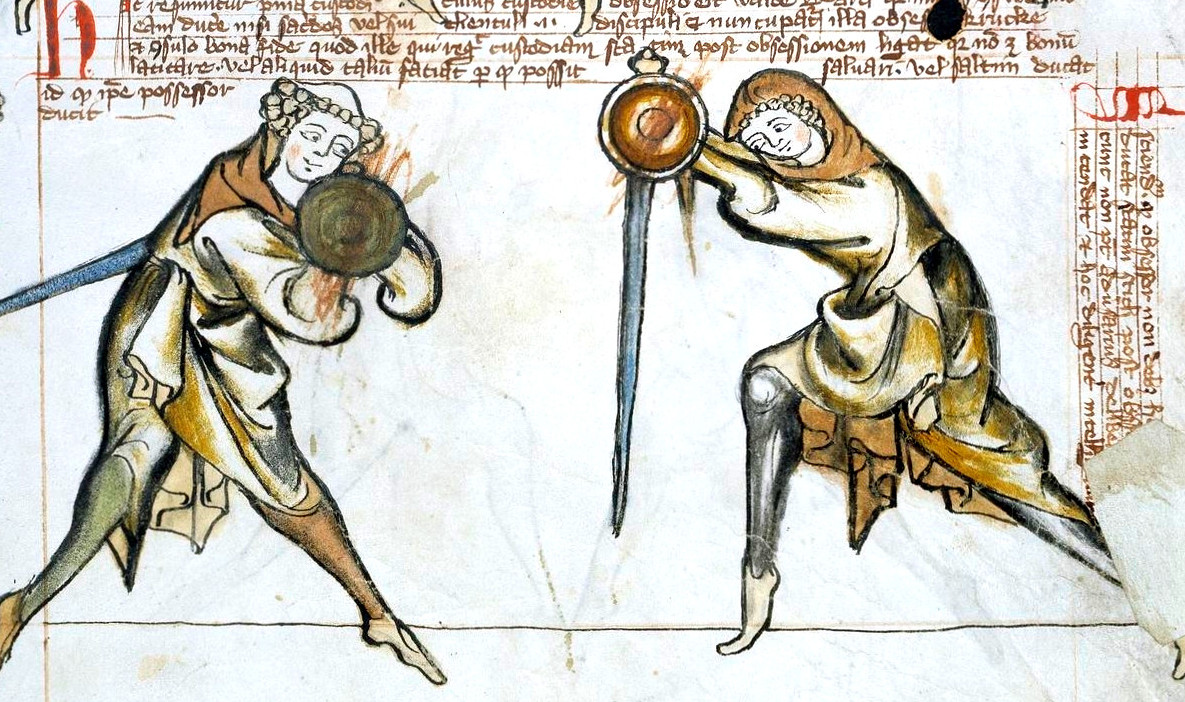
What is she actually doing? She is approaching in such a way that she blocks Ludger's most likely counter, i.e. a diagonal upward cut. In other words, she figuratively 'sits upon' his possibilities to act from the guard. There simply is no single word to translate this idea into English - 'block' would be tempting but misleading because it usually deonotes a static parry in fencing and moreover is needed to translate defendere 'to defend' in the manuscript. 'besiege' captures the imagery reasonably well but is hard to understand for a modern reader, 'displace' hints more at a different concept... A good case can be made that what happens is that Walpurgis makes a tactical threat to approach into fencing measure - that captures the probable meaning, but clearly not at all the wording of the original. *** As far as the German terms are concerned, most of them can reasonably be understood by either their translation and/or the illustrations. For instance krucke (crutch) is evidently named such because that is what the position of the sword visually resembles and the same is true for vidilpoge (fiddle-bow) in 22r. For others, the translation is descriptive. The term langort translates as 'long-point' - evidently the guard is named such because the point is (or can quickly be) extended forward (the term is well-known from later longsword manuscripts). schiltslac 'shield-strike' is named such because the fencer strikes with the shield, stich simply means 'thrust' and schutzen 'defending'. A term like halpschilt ('half-shield') isn't chosen because of a visual resemblance and isn't descriptive, but the illustration is pretty clear on what the fencer does. This leaves only a few terms - nucken ('nod', 'poke'), durchtreten ('step through') and the stichschlac ('thrust-cut') for which the meaning needs to be inferred from the flow of the action that is described. *** One action seems to have both a Latin and a German designation - the stich or fixura (thrust). This raises the question whether the author meant to make a difference here, but the gloss to 28v 'here the scholar does a stich (1) and the discussion of a counter to this in 29r 'before above in the third example of the illustrations the same fixura has been done by the scholar' (2) make it reasonably clear that the terms can be used interchangeably.
Interpreting IllustrationsIt is fair to say that the illustrations in the manuscript cannot all be anatomically correct and do not exhibit attempts to draw fighting scenes to reality (we can start with the observation that the serene smile never leaves the face of the combatants, no matter what happens). Several examples for this can be produced, For instance, consider Ludger lunging forward for an attack on 4r:
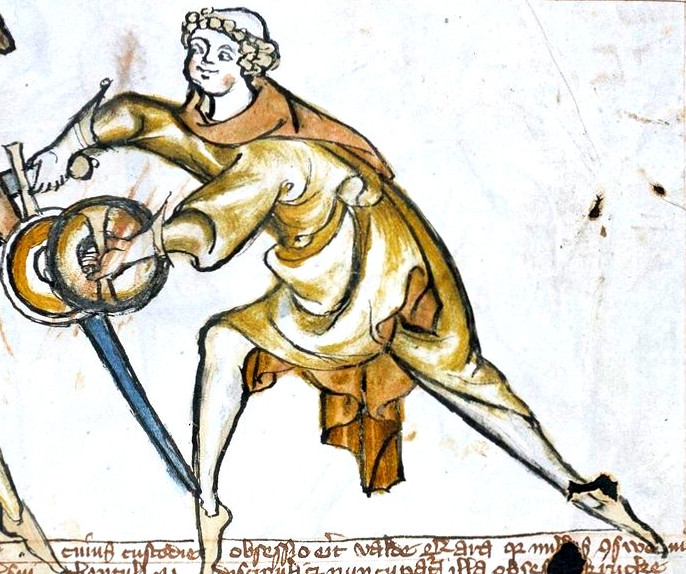
If he really lands on his foot turned like this, he will almost certainly break his toes - the foot cannot easily take the weight of a forward lunge in this position. Standing on toe-tips is actually quite popular in the manuscript while I would not recommend it in a real fencing context - having a secure and stable footing is generally considered useful if the opponent makes a decisive forward attack and and attempt to throw. Yet see how Walpurgis and Ludger are depicted standing in guards in 2r and 15r:
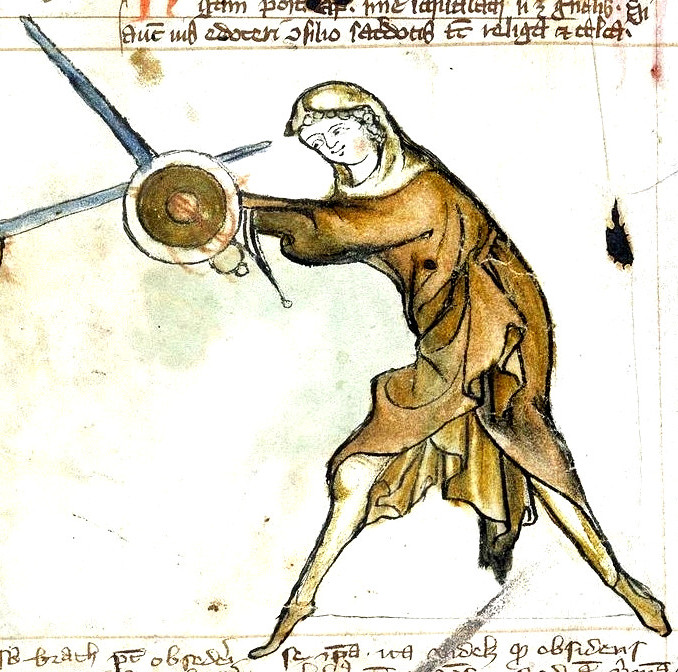 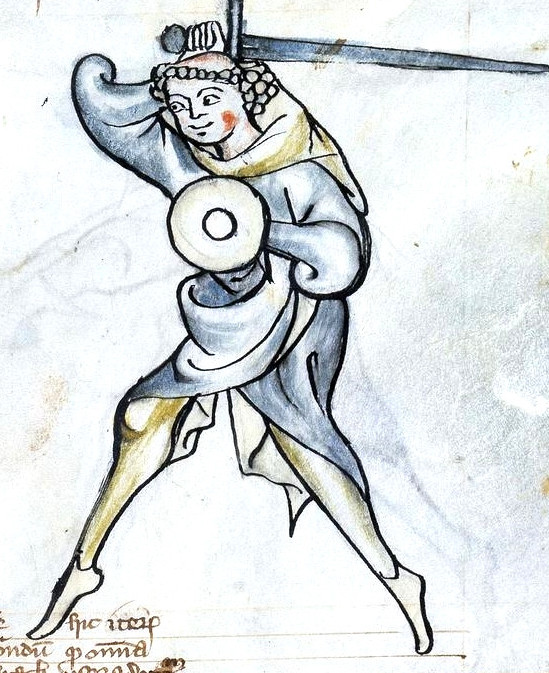
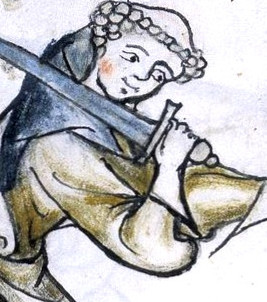
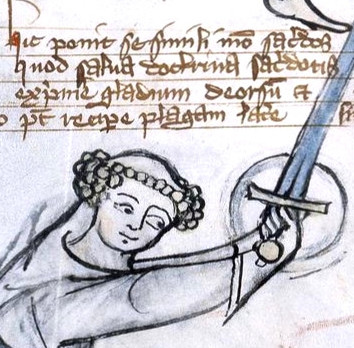
In reality, it would be fairly unpleasant to stand like this for any period of time, much less useful in a fight. A similar case can be made for hand positions. Consider the sequence starting on 9r - Ludger stands with the sword over the shoulder and then extends the sword forward to meet Walpurgis' threat. While he stands in guard, he's gripping the sword to strike with the true edge - but for some weird reason, as he extends the blade he seems to be turning it to threaten a false edge cut (while the subsequent technique actually asks for true edge):
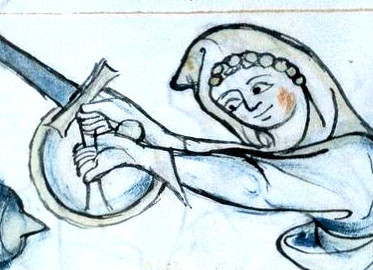
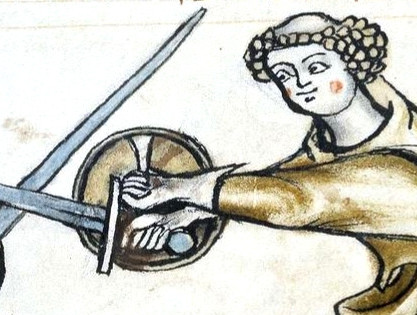
Then again, 10r and 17r show hand positions on the shield that look near impossible to do in real life:
Let's top this off with 4R - Ludger seems to have two left hands (the right hand has the thumb clearly in an impossible place):
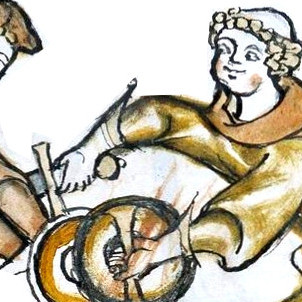
Also the motion depicted is difficult to interpret. Consider for instance the sequence depicted on 6r - the text states the Ludger 'goes in' (sacerdos intrat):
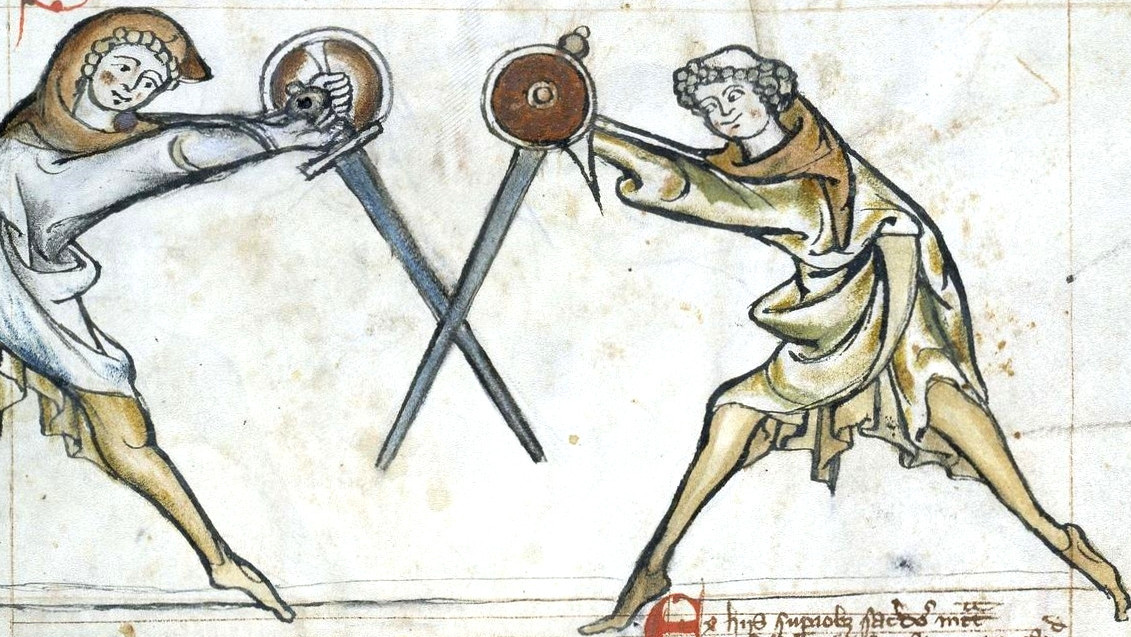 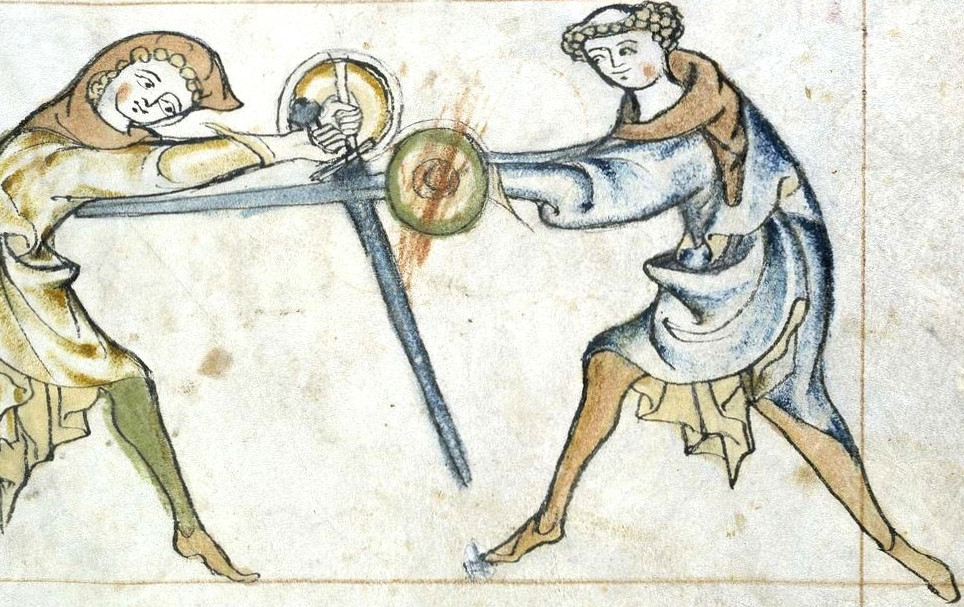
Indeed, he is depicted closer to Walpurgis in the second image - but how did he accomplish this? His body posture doesn't look dramatically different, even his garment falls (on first glance) nearly the same way and the fact that the robes hide the hips and the legs are drawn simplistically makes it generally hard to recognize which leg is left and which is right.
So what it meaningful in the illustrations? Very likely what is also mentioned in the text - the position of sword and shield, the relative position of a sword before or behind the opponent's weapon (indicating the nature of the bind), the direction the bucker is held (generally facing the opponent's blade) and the relative distance between fencers (indicating the urgency of a reaction). Neither details of legwork, stance or gripping sword and shield are given in the text - most likely the author assumes the reader just knows these things if he's interested in fencing and hence didn't mention them and so the illustrator did not emphasize their accurate rendering. Generally, the illustrations resemble religious artwork (likely, that is what the illustrator usually did), the anatomical studies of da Vinci or Dürer are still 200 years in the future at this point.
SummaryOn first glance, the Walpurgis-Fechtbuch appears somewhat cryptic and difficult to understand to most readers. While there are several points in the manuscript which indeed require interpretation through understanding the sequence of actions that is described, there are many factors which make the manual seem more complicated than it really is:
Original quotes (English translations above by myself): (1) HIc scolaris ducit stich (2) Prius quam superius in tertio exemplo ymaginarum fixura quedam ducta est per scolarem
Liber de Arte Dimicatoria on Wiktenauer Back to main index Back to Swordfighting Created by Thorsten Renk 2025 - see the disclaimer, privacy statement and contact information. |