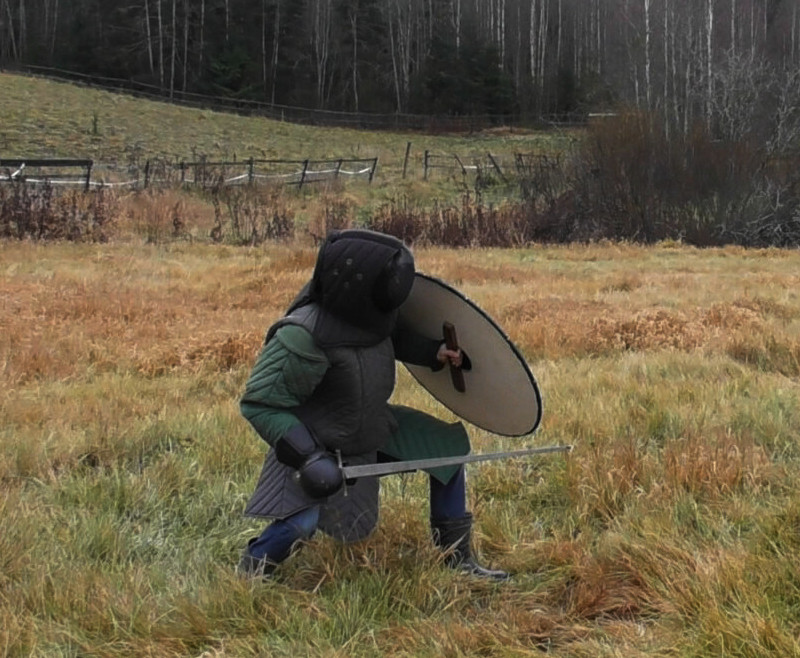
Tactics in Viking Single Combat with Sword and ShieldThe written sources that describe the medieval art of fencing start early in the 14th century, the Liber de Arte Dimicatoria (also known as Walpurgis Fechtbuch or I.33) which describes the use of sword and buckler being the first prominent example. What comes before is increasingly in the realm of conjecture, we have no source that describes what the Vikings thought about fencing with sword and shield.However, this doesn't mean we know nothing - fencing techniques have historically faced a high evolutionary pressure to 'work' - a fencer who uses bad techniques just dies in combat. So a reasonable question to ask and study is - given the equipment, i.e. a single-handed sword and a Viking shield - what techniques work? What guards are reasonable, what has to be avoided? What general principles govern such an encounter, what can be reasonably inferred about basic tactics? The following is a collection of my thoughts and experiments on the matter, backed up by my knowledge of longsword fencing in historical theory and practice and by frequent sparring sessions with single-handed sword and Viking shield carrying modern protective equipment (which places minimal restrictions on the techniques that can be safely used).
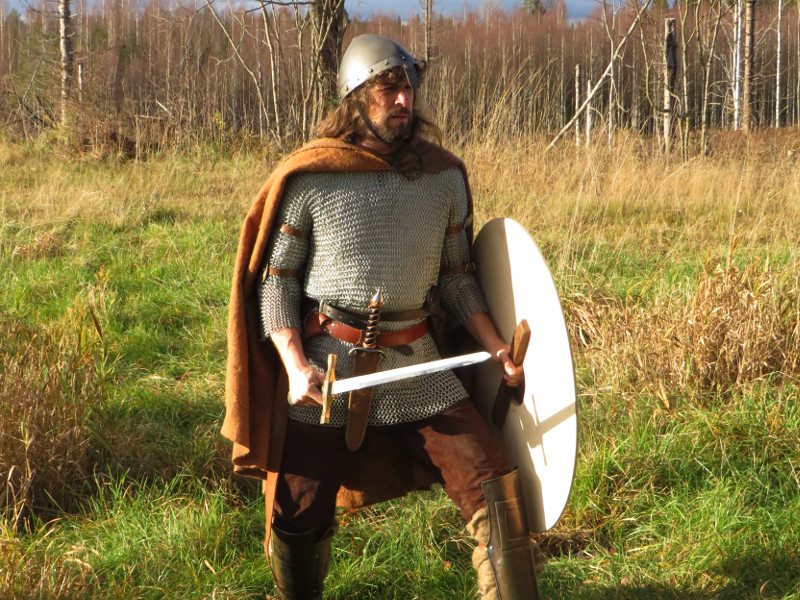 The author in late Viking age combat gear. Note: Most Viking-sword replicas I know are too stiff to use safely for thrusting even in full HEMA gear. I am using a full-contact arming sword with rolled tip for sparring with Viking shield, this bends quite a bit when thrusting and doesn't endanger the opponent. Some basic truthsLet's look first into the foundation of tactics based on observing what the equipment is like. To some degree, these govern what is reasonable to do in fencing and what is not.The shield is heavy and slow, the sword is notA large Viking shield typically weighs between 4.5 and 5.5 kg (although using modern materials like plywood, one can build lighter yet still durable varsions), a sword on the other hand less than 1 kg. Moreover, the sword is used with the dominant hand, the shield not.Thus, in combat, the sword can be moved to a new line and attack much faster than the shield simply due to inertia. This makes feints attractive in which the sword is used to get the defender to commit the shield to a large motion which he then cannot undo in time when the real attack is made. Conversely, when defending with a shield, it is important to not over-commit to a motion.
The shield isn't transparentModern police riot gear has transparent shields, and the reason is obvious to anyone who has ever done a high block with a Viking shield - while the shield protects the head, the defender is essentially blind.
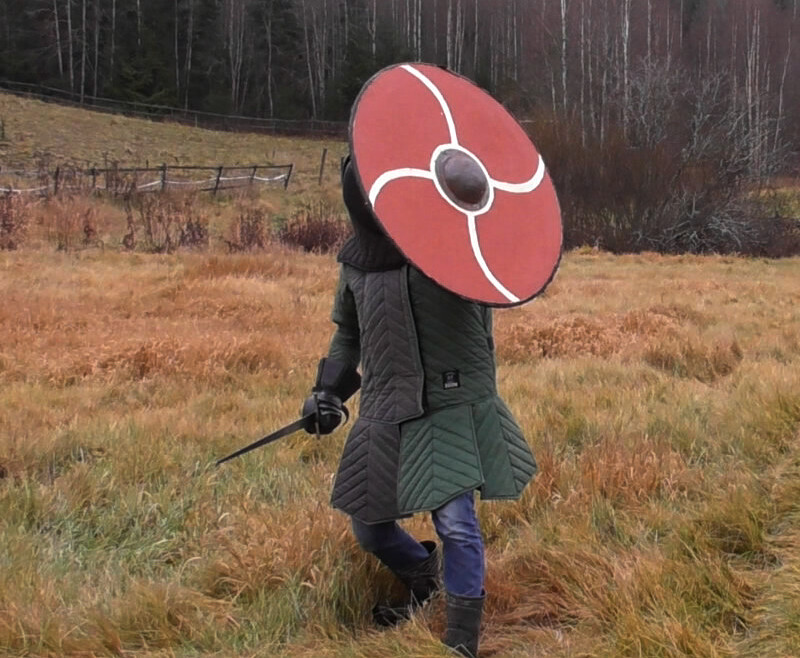 A high shield block disrupts the line of sight. This is a large part of the sparring experience - over a significant period of time actions need to be done without having a clear visual picture of what the opponent is doing at the moment. Tactically this gives rise to techniques which aim to blind the opponent by forcing him to a high block and use the window of opportunity to change the line of attack to an unexpected direction. Generally, fencing with large shields requires the ability to mentally assemble a good picture of where the opponent must be and what he is likely doing even if he can't be seen, just based on tactile information and maybe seeing his footwork.
The shield is held, not strappedViking shields have a handle, they aren't strapped to the arm but held just like the sword. This has a profound tactical impact, because it means that in principle the shield can be held far from the fencer at arms length (in practice this is pretty exhausting due to the weight) and it can be turned to face the opponent with the flat surface or the rim as needed. This makes the use of the shield fairly flexible. Especially the ability to hold it at arms length favours techniques in which the space is taken away from the opponent, i.e. his actions are inhibited by holding the shield close to him (this can be in a bind or not).Of course, the idea of strapping a shield to the arm came for a reason - a shield is heavy and tires out the arm quickly, so when using a Viking shield, care must be taken to rest the shield arm whenever this is possible.
The shield is largeAnyone who has learned longsword fencing knows that the sword only ever protects one of the four openings. Thus, the basic tactical problem of longsword fencing is not finding an opening to strike, it is creating a situation in which it is possible to strike without danger of a counter-attack.In fencing with sword and shield, this is completely different: The shield nearly covers two openings and the sword takes care of a third one, so it is a genuine problem for the attacker to even find an undefended opening - while his own shield can always keep him protected while he attacks. (Many longsword plays and techniques thus do still make some sense when applied to fencing with a single-handed sword, but cease to be useful when a shield comes into the fray).
It is better to intercept attacks far away than closeA good defense generally doesn't rely on a single factor but rather works as layered defense. It is good to cut away an attacker's weapon, but better yet to simultaneously step out of the line of attack at the same time in case the parry doesn't work.For that reason, catching an attack far from the body is better than letting it get close, because even if the parry fails, distance might still offer a measure of protection. This means that a shield should not be used as a static piece of armour which is held close to the body and hardly ever moved, it should be used much more actively. When an attack is coming, the shield is stretched out to meet it. Because of the way a shield is formed, more distance can be gained by not using the flat surface for the block but rather the rim. Conceptually, the idea of a shield block is often more akin to to pushing the blade away with the rim than to present a flat surface and wait for the impact.
A one-handed sword is too short for quick leg attacksIt is tempting to just attack below the shield, and indeed with a longsword against a Viking-style fencer, this is a viable tactic, but a one-handed sword is too short to make this work. From any normal stance, the sword has to be angled so much to target the legs that the reach is just too short, one would have to almost go to wrestling distance.A leg attack is easier when crouching down before or during the attack - but this is a full-body motion rather than an arm motion and so it is much slower, giving the opponent ample warning time of what is about to happen.
GuardsThe basic guard then would have the shield forward (to present the first layer of defense as far towards the opponent as possible) and the sword pulled back (both to avoid attacks to the blade and to be able to bring the weapon forward quickly with a passing step when attacking like Meyer advocates for Dusack). The shield isn't held flat but with the rim forward, covering most of the high and low left openings.
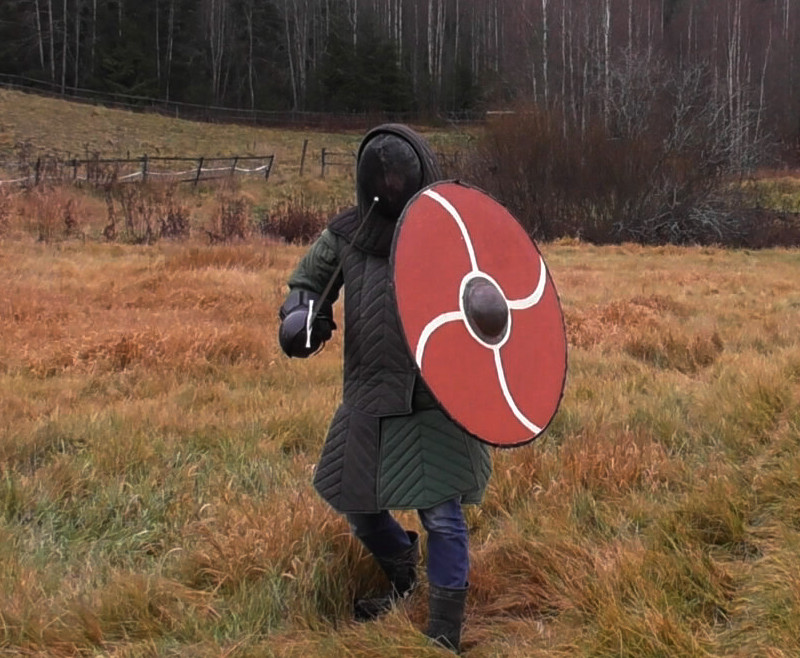 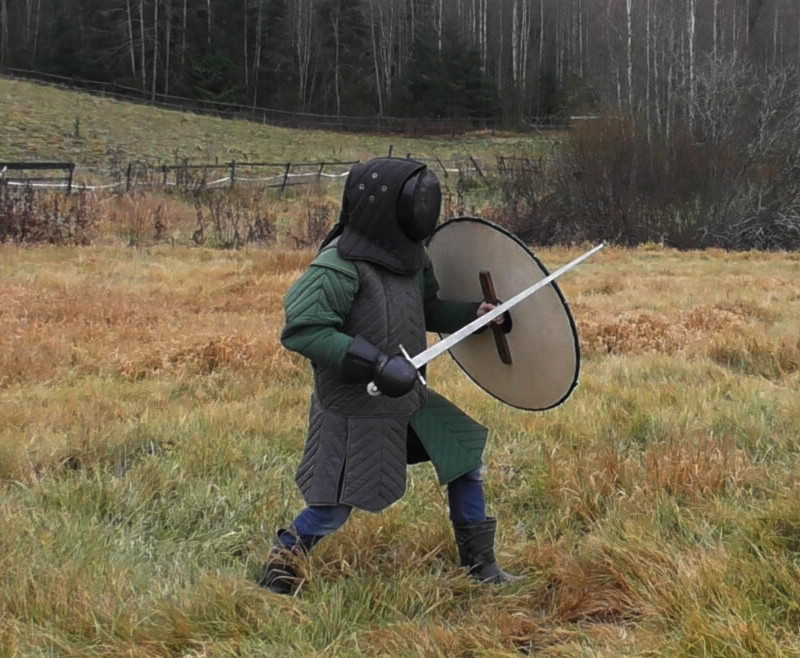
Basic guard from the front (left) and the right side (right) In contrast, standing with the sword facing forward doesn't provide any significant advantages - the position is rather open, the main defensive device is too far back to be of much use, the sword cannot be brought forward quickly to attack - the main advantage would be to attack with the shield first, but that is a questionable tactical choice (see below).
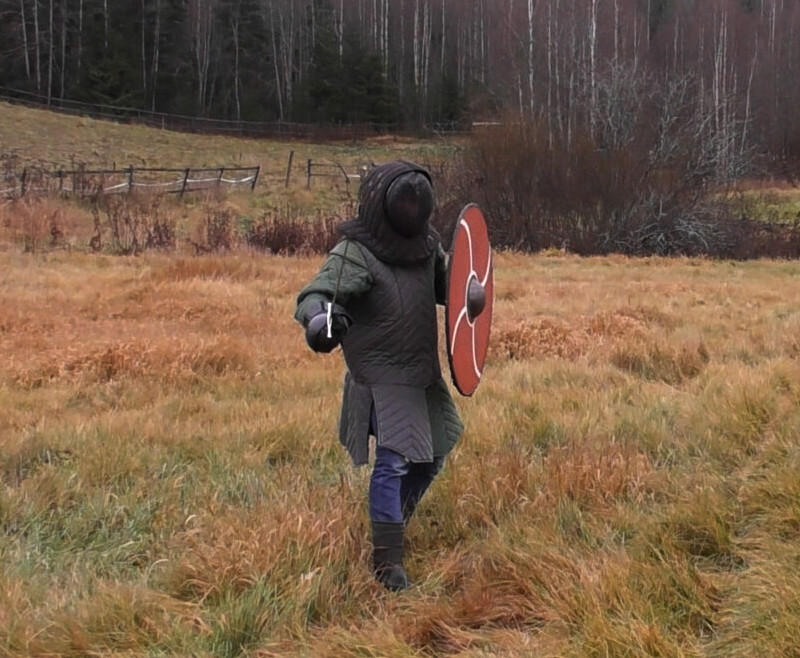 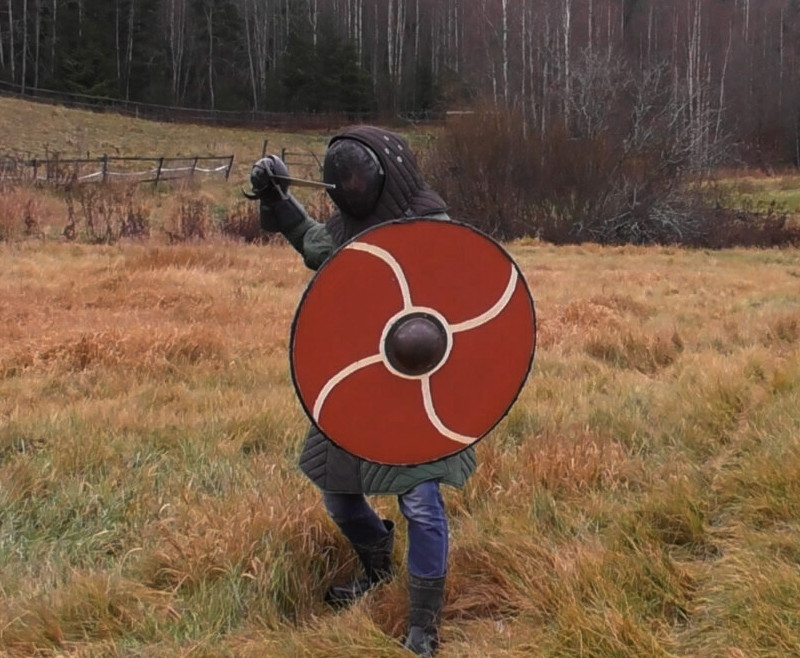
Sword in front results in an open position (left), shield resting on knee is closed, but limited in mobility (right) , Another position to hold the shield for an extended time during Zufechten has the shield arm rest on the left shoulder, keeping the shield next to the head. 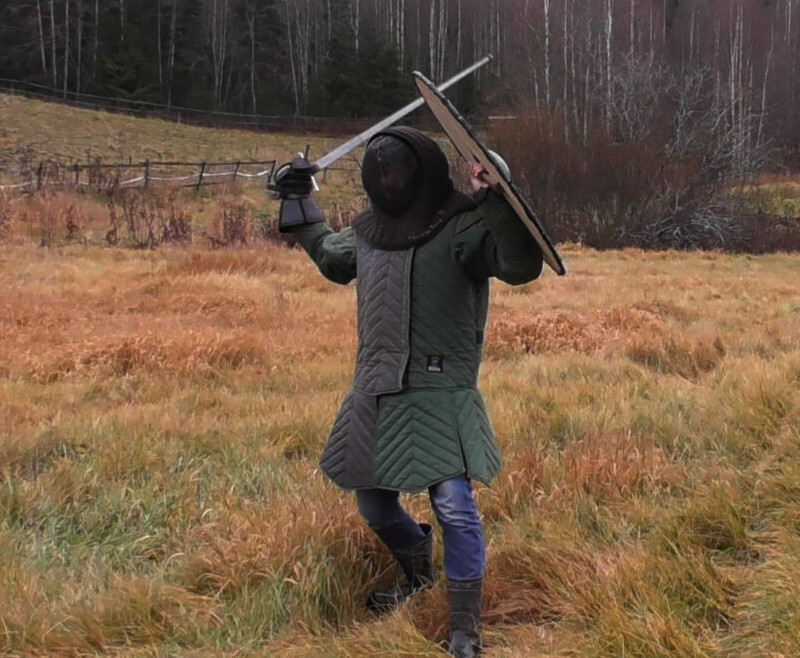 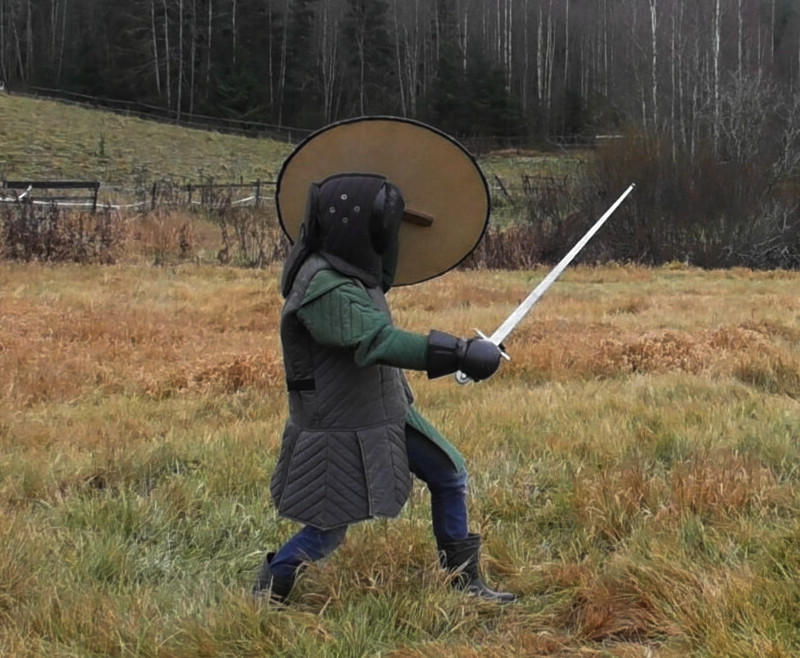
Shield on shoulder position from front (left) and right side (right) Where then should the sowrd be held? Tactically this is a minor issue. In the attack, the sword needs to be brought forward for a cut or thrust. If the sword is held in a thrusting position (as in the above right picture), it is easy to open with a fast thrust - but if you actually do the obvious thing from a position, you give away much of your intentions. Likewise, if the sword is held in a overhead cutting guard, a quick cut downwards is easily made - but again, if that is your plan, you give away too much information to the opponent. There are thus two basic choices - either you learn to do an attack from a position that is not obvious (i.e. thrust from a cutting guard), or you have your sword in constant motion from one position to the next so that the opponent cannot deduce when the attack will come. Leaving the sword in the center closes another opening on the right, but in turn exposes the wrist and the blade to attacks. Pulling the blade over the head or back opens the guard more to surprise attacks, but reduces the risk of attacks to the blade. Basically this depends on the opponent - if he likes to try quick surprises, I'd keep my sword in the center, if he likes try to cut the blade away or force binds, I would pull the sword back to deny him the opportunity.
Attack techniquesAs mentioned above, the main tactical problem that needs to be solved when attacking is to find an opening since the shield creates an easily defensible position. Just hitting the shield may feel rewarding and produce impressive sounds, but tactically it accomplises nothing (in fact, it is a tactical mistake as it commits the sword to an action that has no purpose).There are various ways to approach the problem - some direct, some indirect. Let's go through a couple of them.
Into the opening - direct surprise attacksThe most straightforward way is to attack whatever is exposed of the opponent. Usually this is the head, dependent on how the sword is held it may be the wrist, if the shield is facing rim forward there is a small space in the center that can be attacked with a thrust, if the shield rests on the knee the upper leg is a possible target.
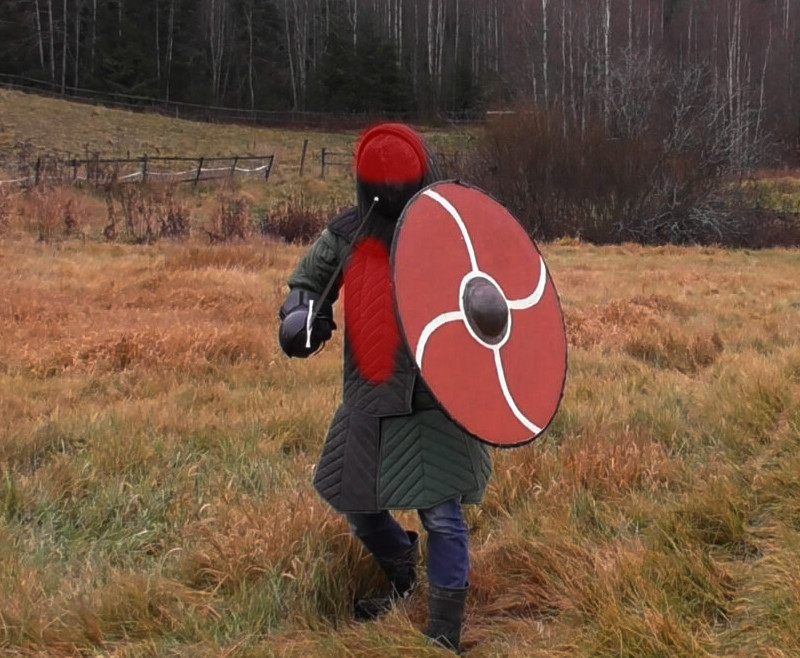
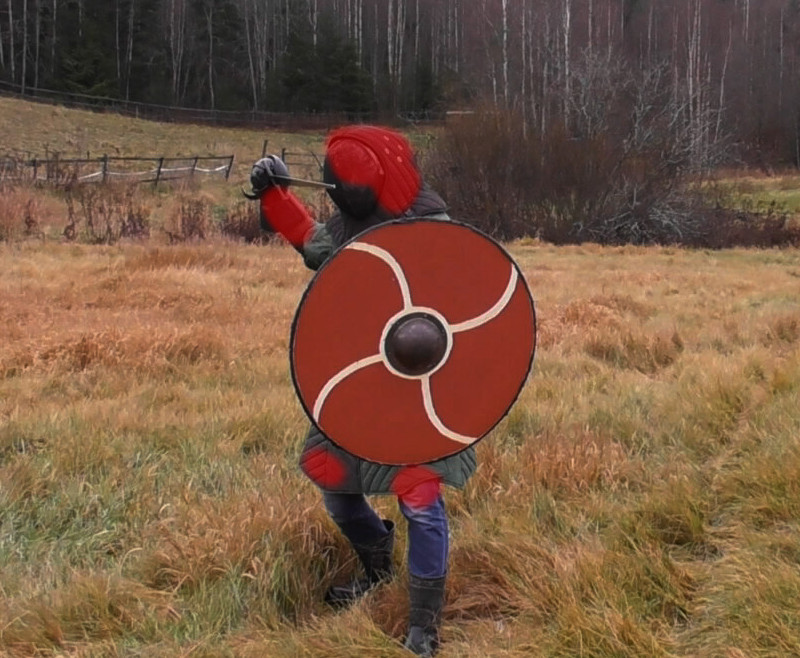
Targets for quick direct attacks for different guards. As a rule, thrusts work best for such quick attacks because they are fastest to do and have the farthest reach. If a cut is used to the head, a throwing motion that mainly comes from the wrist works better than a cut with the full arm because the first variant penetrates farther behind an attempted parry. Because the openings are small, any thrust requires excellent control over the point of the sword and all attacks have to come very fast and explosive to have a chance of success. The sequence of actions is attack, raise shield and retreat (if the opponent counters, the counter must come high because it is close to impossible to hit a retreating opponent with a single-handed sword on the legs). Removing the shield - combination attacksThe general idea of a combination attack is to open with a threat that forces the opponent to react, then use that reaction to do the real attack.One straightforward combination is as follows: Open with an attack to the head. This forces the opponent to raise his shield to defend, but in doing so he will lose visibility. In that moment, bring the shield forward to pin the opponent's shield in place with a shield bind (this also takes away his space to attack), use the momentary confusion to thrust below the shield, then immediately pull back and retreat with shield high. The sequence of actions is an alternation of the focus between sword and shield: sword threatens, shield exploits and takes away space, sword attacks, shield goes up and covers the retreat. An important issue is that the attack is best directed towards the opponent's left side, i.e. is done stepping right around him. In this way, the two shields act as a block that prevents an effective counter-attack. The precise actions to be used can vary, for example once the opponent is temporarily blind, it can be equally effective to stay high, wait for him to lower the shield in the belief that the attack is over and then thrust again to the head. Also, the first attack doesn't necessarily have to force the opponent to raise the shield and block visibility, it may equally well serve to bring him into a different position in which his shield can be pinned. Often, the real attack will have to be executed while the own shield clears the space and holds the opponent's actions off, which means a thrust at a target one cannot see behind the shields. If one is used to fencing with a longsword or single-handed sword without a shield, the required attack position feels unusual and possibly even a bit awkward.
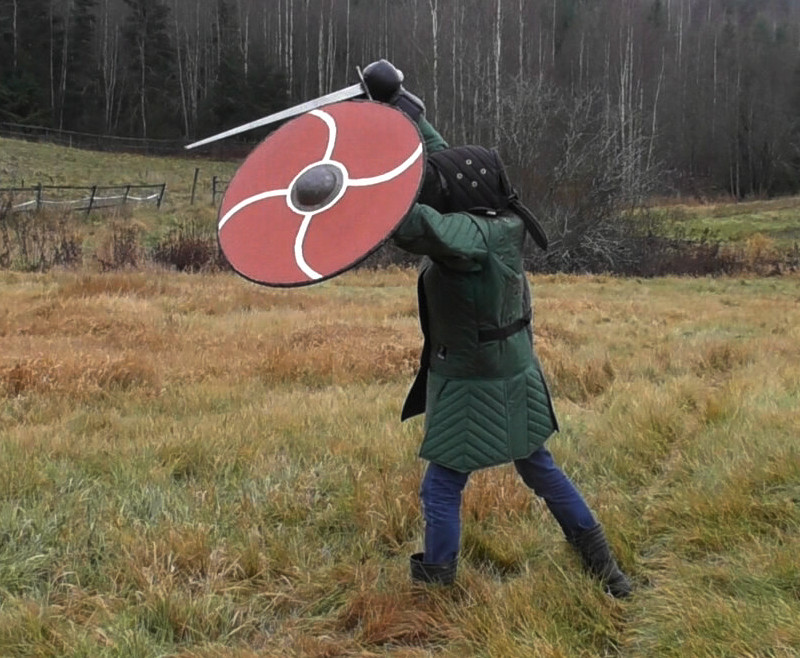
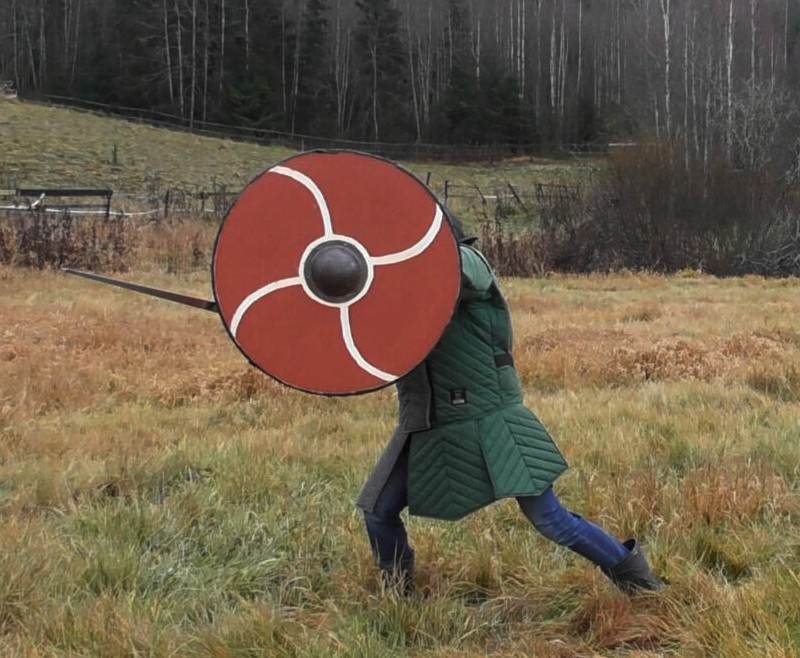
Thrusts past the shield, high (left) and low (right).
Through the shield - using leverageHistorically, shields could indeed be destroyed in combat (and in that sense it is possible with sufficient force to really attack through a shield), but generally an axe is a much better weapon than a sword for that particular purpose. This is not what is meant here though.The theme here is that a Viking shield is held, not strapped. That means that for a rotation around the handlebar, the lever-arm of the hand on the handle is very small - which makes it hard to resist pressure (this is not at all an issue for a shield strapped to the arm). A sufficiently strong attack to the indicated areas below will thus be able to turn the shield sideways and so push through the defense.
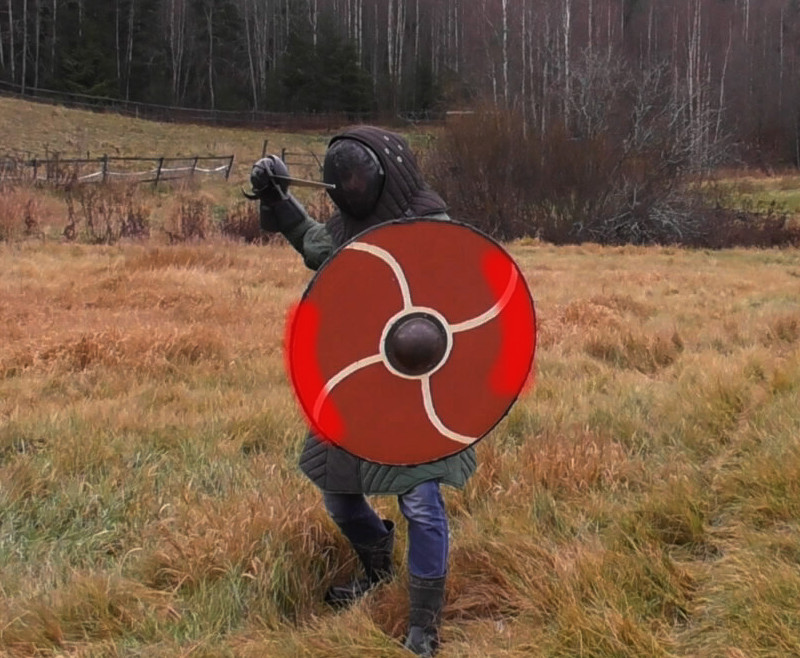 Target areas for attacks that can turn the shield and penetrate. Such leverage attacks can only be done of the opponent presents the flat surface of the shield, either as a guard or a block. If the shield is used more dynamically to parry, in particular if attacks are deflected with the rim or if the shield is held rim-forward, any attampt to apply pressure will just slide off.
To the sword - blade attacksBy stepping to the right side of a fencer, i.e. moving a good step left, it is possible to temporarily create a situation in which the two swords face each other on the center line and the shields are located at the tactically insignificant outside.Once that situation exists, a number of single-hand sword techniques can be used (see e.g. Meyer's System for Dusack). For instance, a feinted high cut can lead the opponent to raise his blade to meet it, once he does the cut is changed to a low cut targeting the wrist. Alternatively, the attack can aim to cut the opponent's sword away and then thrust into the gap, making use of the fact that the opponent might have a hard time bringing the shield so far to his right. Or the attack can seek a bind and thrust along the bind. As opportunities for such attacks are short-lived (the opponent just has to sidestep to bring his shield into action again), the action has to be fast and decisive. The own shield isn't used at all, in essence the idea is to force the opponent to fence sword against sword.
Creating opportunities - second intention attacksThere is another way of utilizing the temporary loss of visual contact when a shield is raised. The idea is to make an attack the forces the opponent to bring the shield up, maybe even make a brief shield bind - but then to retreat quickly before a counter can come and lower the owen shield.Normally, at this point the opponent will need a moment to lower his own shield and assess the situation. This is the moment in which a direct attack into an opening can succeed well, even if it is not terribly fast, because the opponent is still desorganized. So in a sense this is a second intention play - the first attack only serves to create confusion, it is never meant to score a hit (although it is nice if it does) - the real intention is with the second attack. Of course, just having failed to land a combination attack and seeing an opportunity to follow up after a quick retreat works equally well as having it planned all along.
Blunt force - attacks with the shieldJust as the pommel of a sword is conceptually a valid weapon to attack, so is the shield. An attack with the shield can be done surface-forward or rim-forward.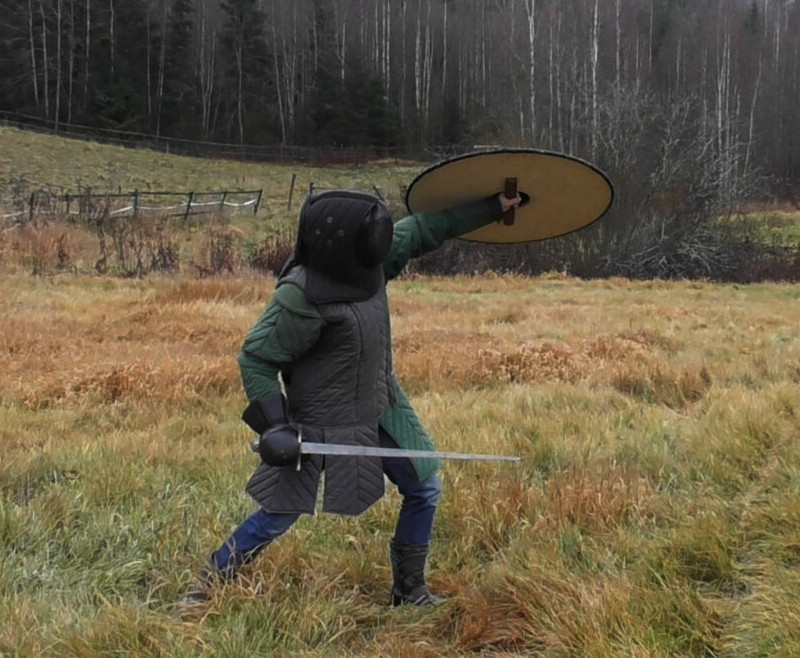 Using the shield to attack rim-forward. Note: A dedicated rim-forward attack with a 5 kg shield to the opponent's head is dangerous even in HEMA-gear. Fencing masks simply aren't made to withstand this kind of impact, so I don't believe these techniques can be safely used in sparring. Let's start with the surface-forward attack. The idea is to take the space away from the opponent before starting the actual attack. While this works great when the opponent has a longsword (it tends to leave a panicked opponent who doesn't have room to do anything with his weapon who can be attacked at leisure), this is not so when the opponent has sword and shield. Conceptually, the idea of moving the shield forward to a bind is the same as outlined above for the combination attack. However, while the combination attack prepares this by putting pressure on the opponent before the shield is used, a surface-forward shield attack aims to do the same without preparation. Moreover, as outlined above, the shield is a comparatively slow weapon, so such an attack gives the opponent significant time to prepare. Offering him such an opportunity is tactically simply inferior to the combination attack - so the idea of directly seeking a shield bind may or may not work, but the same thing can be more reliably accomplished by preparing with a sword attack. As for the rim-forward attack, this has the idea of directly and forcefully striking the head of the opponent. As mentioned above, I do not know for sure whether it would work in sparring, but as any shield attack, it is comparatively slow and so it would probably need the element of surprise to actually hit the opponent.
Defensive techniquesThe obvious defensive device when fencing Viking-style is of course the shield. But as it covers mostly the left side, the further from the right an attack is coming, the more useful is the sword to defend. Finally, also distance can be used to fend off an attack.The idea of any defensive technique is, just as in longsword fencing, not only to block the opponent's attack, but to actually break it and in doing so gain the initiative for a counter-attack - blocking is enough to keep a fencer alive, but not to let him win.
Shield parriesWhile the shield is large, it actually has to be moved somewhat to fend off attacks that are not directly towards the shield. In particular, it has to be raised to fend off attacks towards the head and lowered (best combined with a bit of crouch) to fend off low attacks.

Blocks high (left) and low (right) with the shield. The most crucial issue here is that raising the shield to protect the head inevitably blocks the view and thus gives the opponent the chance to prepare a follow-up attack. It is thus a good idea to retreat when doing a high block so that the threat of a quick follow-up low is neutralized and to lower the shield as soon as possible. Another important issue is, as mentioned above, the need to avoid overcommitting - as the shield is heavy, once it is moving into a given direction, it is comparatively hard to change its motion. Also, shield blocks should conceptually not just consist of holding the surface into the path of the attack, rather the attack should be deflected by the edge of the shield. The easiest way to try to get the initiative in a shield parry is to combine it with a thrust where the shield is not, i.e. do a low thrust with the sword when the shield blocks high or a high thrust when the shield blocks low - of course the opponent still has his own shield to ward off the counter, but then again, he might not.
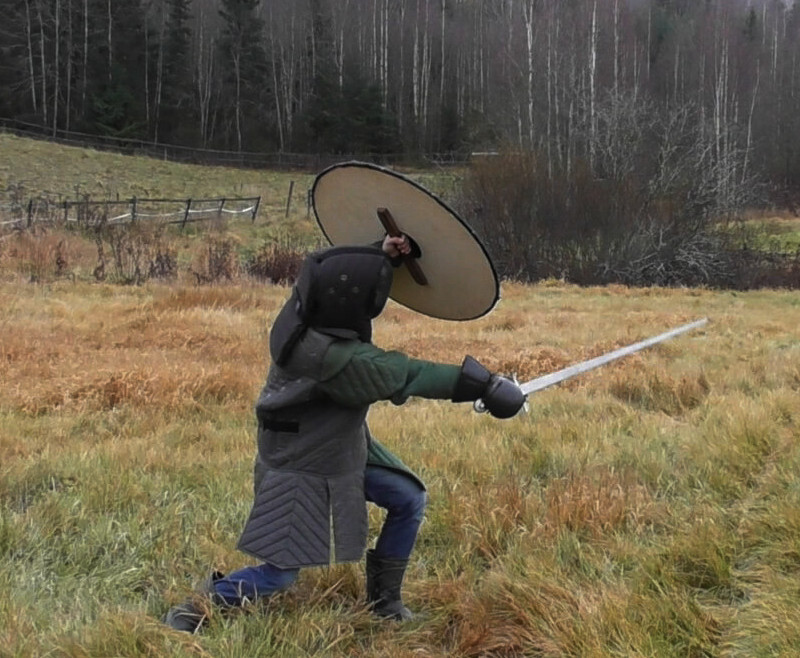 Simultaneously blocking high and countering low.
Sword parriesWhile the shield is the most obviosu defense, the sword does just as well. In fact, defending with the sword may offer a few advantages.
ideally, a sword defense should not just be a static block (which merely buys some time) but a at least a cut against the attack (or even a counter-thrust or counter-cut). For instance, if the defender manages to cut a high attack away, he has two advantages: First, unlike for a shield parry, he never needs to block the line of sight. And second, for a short time window while the attacker needs to get control of his blade again, the defender has a sword and a yet uncommitted shield to launch his counter-attack, an advantage that could be decisive if used right.
This works fairly well for longsword and single-handed sword just because the opponent is wide open after cutting too short, but the same just isn't true in fencing with sword and shield - even if the blade is out of the way, the shield is still in place and a counter-attack still has to overcome the shield. As a result, distance plays aren't quite as attractive in Viking single combat as they are in other variants of historical fencing.
Perhaps more importantly, any attack with a heavy shield has lots of momentum flowing into a particular direction, the attack by its very nature has to be rather committed - and so it is difficult to change its direction.
The obvious tactic to counter such attacks is then to simply sidestep, use the own shield to let the opponent's shield glance off and in turn attack the opponent from the side.
If the attacker brings his shield in high, an alternative might be to crouch down behind the shield (which is a rather safe position) and then thrust from below.
Such feints are easier with a light weapon than with a heavy weapon (because the inertia of a heavy weapon makes it more challenging to change the line) and easier with a two-handed weapon than with a one-handed weapon (because the torque generated by pushing with one hand and pulling with the other is greater than the torque generated by wrist motion). This is why feints are attractive to do with a longsword, but not at all with a single-handed battle-axe.
On the face of it, there is a case to be made for feinting against a shield defense, because the sword is much lighter and faster. But it isn't that simple. First of all, feints work reasonably well when attacking left, aiming at the opponent's sword hand (as I said above, this is in many ways akin to single-handed fencing). When trying to feint against the shield however, it runs into a few issues:
First, the impact of a weapon on a shield isn't as noticeable a cue as blade on blade (again shield inertia) - the defender doesn't instinctively wait for it the same way and isn't surprised by its absence. But second and more important, the shield is large. It isn't enough to alter the line of attack only slightly to reach around the shield to an opening, the line has to be changed massively - which takes a lot of time. Of course it takes even more time to bring the shield around - but this means the relatively small time interval gained by not impacting on the shield is tactically near-irrelevant. Avoiding the impact primarily puts more strain on the wrist without accomplishing much - so the attacker might as well let the shield do the work for him and stop the blade.
Thus, I would feint against the opponent's sword, but not against his shield.
While I have above used the term to describe a transient situation in which the shields push against each other while an attack is made, the idea of Warzecha goes quite a bit beyond this - it to seek a bind with the opponent's shield, then maneuver to gain a mechanical advantage to push the defender's shield aside to create an opening to strike with the weapon.
For starters, I don't think that is what has historically been done. The sagas describe mighty blows, sparks and smashed shields - single-combat using the shield bind looks more like tactical maneuvering with a quick stab in the end in which none of this happens - instead the saga descriptions are entirely consistent with shield blocks and attacks to the shield and sword.
Perhaps one shouldn't over-stress the fidelity of saga descriptions. But to my mind, there's something intrinsically wrong with the idea that if I have a light 1 kg weapon in my right hand and a heavy 5 kg shield in my left hand that I should do most of my attacking with the left hand - it seems inefficient (of course the proponents of Warzechas system also tend to believe the shields should be much lighter, something I don't believe based on archaeological evidence, see The Weight of Viking Shields). In addition, it is notoriously difficult to engage an opponent in any kind of a bind if he doesn't want to - all he has to do is control distance carefully and not get too close, yield ground when needed and sidestep attacks when the shield is brought forward.
It may be in the end that Warzechas system is about something different. The sparring match videos I could see with the technique I would describe as low intensity, low speed - usually fencers aren't even wearing full protective gear (to provide a comparison, I spar with opponents who can explode into a thrust that takes less than 200 ms till it lands - faster than a human reaction time - such actions aren't even properly visible on video without slow-motion capture).
Now, take a relatively light 2-3 kg shield and a sword that is limited in speed by the low intensity (you simply can't attack someone who isn't wearing protection with a full-speed thrust withiut risking severe injury)- and suddenly the difference in speed between sword and shield become irrelevant, the shield actions are just as fast. To this different tactical situation, sophisticated shield bind techniques may very well be the correct answer, but I seriously doubt that they're equally well suited to a high-intensity match or a life-and-death situation like single combat.
While this works well for longword or Dusack, I don't think the idea is equally effective for sword and shield.
The way these attacks are done with a longsword or Dusack is to keep the hands roughly in front of the face and then start cuts with fast, relatively small motions - this is sufficient to force the defender to a new parry of he has a sword. Not so if he has a shield - to make a different threat, the sword motion for the attack has to be quite a bit larger, otherwise subsequent attacks will just impact on the shield even if it is not moved at all. But that slows the sequence down - and this takes a lot of the attractivity, because when attacks come slower, the defender actually has time to come up with a counter.
Granted, the above is only a rundown of fairly basic tactics, of course there is also the whole psychology of lures and threats that allows to control an encounter better, meta-tactics that assume the opponent knows a particular tactic,... but I have some doubts if the Vikings ever used much of that.
Skills that would then seem to matter in Viking single combat are thus speed and good control of the blade for quick thrusts and strikes into gaps in the defences, a good mental picture of what the opponent is doing for situations in which the view is blocked by the own shield, raw strength to keep proper stance and quick defense with a heavy shield and a clear head to deal with the inevitable confusion and quickly re-organize after a close clash.
Viking Fighting Notes from 23 Sagas by the Association for Renaissance Martial Arts
Created by Thorsten Renk 2025 - see the disclaimer, privacy statement and contact information.
|