FeintsMisdirecting the opponent's attention has through the ages been an important part of any tactics. In the context of swordfighting, such misdirection often appears in the guise of a feint.Historically the idea has been expressed in quite different ways - Fiore knows the punta falsa ('false thrust' or 'false point') which appears to emphasize the inherent duplicity. This is also apparent from the explanation which emphasizes 'making it look like an attack': This play is named 'The false Point' or 'The short Point' and I will explain how to do it: I make it look like I am making a powerful attack against my opponent with a crosswise strike to his head. As he makes cover I strike his sword but only lightly. Then I quickly turn my sword to the other side of his blade, gripping my sword with my left hand at about mid-sword. From there I can quickly make a thrust into his throat or chest.(1)
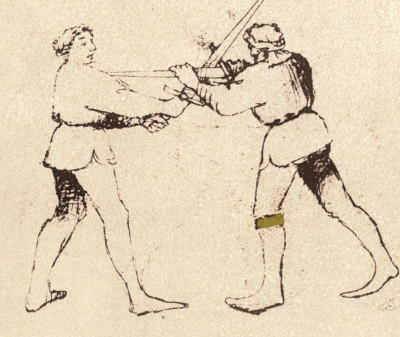
When you come to him in fencing, act as if you would cut a Zwerchhau on his left side to the head but pull your sword in the cut around and cut across to the other opening Joachim Meyer in turn emphasizes the idea of a cut that 'misses' its apparent target intentionally: Certainly anyone can miss, but to use that properly and at the right time only an experienced fencer knows how to do. Therefore, if you want to do a strike that misses to your advantage so that you recover a second [strike], so observe: If you strike to an opening and your opponent wants to parry, don't allow the blades to touch but strike to another opening.(3) Somewhat surprisingly though, feints are not discussed very prominently in manuscripts prior to Meyer's Gründtliche Beschreibung der Kunst des Fechtens. Feints vs. other misdirectionIn the following, we'll call the above concept a 'feint' - a specific misdirection in which a first attack is used to force the opponent to a defensive reaction, followed by the real attack elsewhere.This is only a specific application of misdirection in fencing (which is a much broader concept). Consider a play in which a fencer opens with a thrust and then cuts to the right hand - which the opponent blocks. The fencer repeats the action, letting the opponent think he has figured out the attack pattern - but on the third attempt, he opens with the same thrust but cuts to the left side. This clearly is a misdirection (the opponent is led to think that he understands what is going to happen), yet it isn't a feint in the above sense. Equally, a fencer might stand in a high cutting guard with the sword raised over his head, making the opponent expect a cut from above - yet he might actually attack with a thrust. This, too, is a misdirection of attention, but not a feint as outlined above.
Anatomy of a feintIn practice, there is a fluid continuum between feints and second intention play - Fiore for instance advises to 'make it look like (...) a powerful attack' but then 'strike his sword only lightly', so the deception is chiefly about the force of the attack, whereas the Ringeck and especially the Meyer quote emphasize to 'not allow the blades to touch' - i.e. the intended deception is really about where the attack lands.If the initial attack is with sufficient energy and commitment and is met by a block, but the attacker has already formulated a plan how to follow-up, the action is a clear second intention play, if the initial attack never meets a block but is changed before, the action is clearly a feint, but any scenario between these clear-cut cases can occur in practice. The advantage of a feint over a second intention play is the element of surprise and the inertia of the defender's blade: When blade contact occurs, both blades are stopped. However, when the defender expects a blade contact which doesn't come, he not only needs a split second to realize that something is wrong, but during his split second his sword still moves into the wrong direction - and he still has to stop that motion and bring it around. A well-executed feint thus lives off the difference in commitment to the offensive vs. defensive action - the idea is that a low commitment attack (which can easily be undone or changed to a different line) is met with a high-commitment defense (which the defender can not easily change and so gets hit). A relative beginner which responds to a small blade motion with a big defensive motion is easy to feint, an experienced swordsman who usually gives measured responses and matches commitment is much harder to feint. The idea of a feint as outlined by the medieval fencing master is then in modern terms summarized by a trinity of actions that the attacker has to perform:
The threatThe point of 'acting as if doing a cut' or 'making it look like a powerful attack' is to get a defensive reaction from the opponent, so fundamentally a feint relies on making a threat that the opponent has to answer.Unlike the tactical threat of the obsessio described in the Walpurgis-Fechtbuch, the threat in a feint is an immediate threat, at best an appeal to gut feeling that ideally makes the opponent react without thinking. Thus, the threat has to be convincing. At the same time, as we've seen above, the advantage of the feint comes mainly from the fact that a low-commitment threat is met with a high-commitment defense. Thus, the threat should not be real - the action should merely look like a powerful attack but not actually be one. These two seemingly opposing requirements make a good feint a work of art rather than a science - one can not simply drill a motion sequence, but one has to learn to convincingly lie with context, sword and body language so that the opponent reacts to the threat, and this has to be tailored to the opponent such that the minimal threat motion that still gets the desired reaction is used. Let's go through a few important points:
The evaluationThe older manuscripts don't mention this step, but Meyer does - you should not feint blindly, but observe what the opponent is doing. In the event, Meyer recommends different actions dependent on whether the opponent merely blocks or actively cuts:If you cut to an upper opening and you realize that he doesn't cut but merely moves his sword, so don't let your own cut make contact but attack a lower opening, but if he cuts against you, cut with your own attack against the strong of his blade(4) This is sensible advice, because if you threaten high and then cut low, your head is largely unprotected against a high counter-cut. Generally, it pays off to observe the reaction of the opponent to the threat. The following cases need to be considered:
The attackOnce the opponent's sword is properly displaced to the opening intended by the threat, the real attack can be done.Which opening should be attacked then? The rule of thumb is - the opening from which the defender just moved his sword away. In other words, get behind the opponent's sword to the center line. This isn't all though. Going through the examples of feints described in the historical manuscripts, a common theme is that they do the real attack in a way to be safe. Consider the following two example from an illustration of the Ringeck gloss (the attacker is on the right and in the foreground, the illustrations show the decisive attack after the feint):
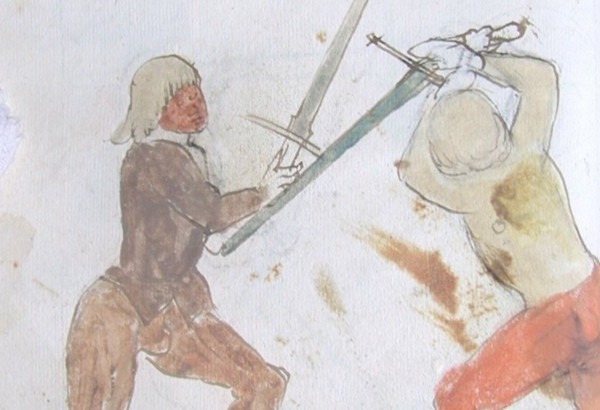 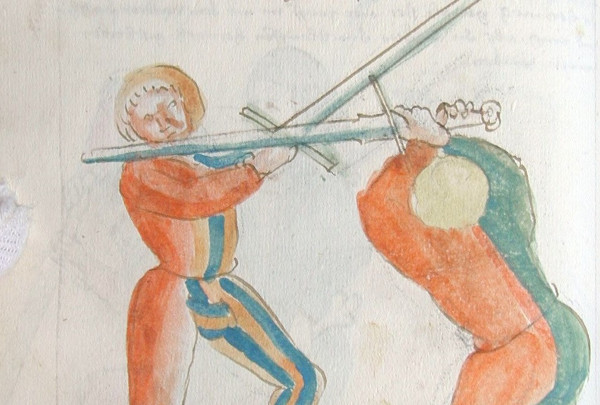
The threat allows to position the opponent's blade somewhere, the attack should then factor this 'forced' position in and be planned to prevent a counter. Threatening a cut to the head will make the opponent rise his sword, that creates an opening at his legs - but it would be a mistake to threaten high and then cut the legs because the opponent has his sword still raised and can easily attack the head. This is an unsafe feint and should thus be avoided.
Technical aspectsThe initial threat can be made using a thrust or a cut. Out of the two possibilities, the thrust is generally more attractive: Just extending the arms and leaning a bit forward - a very low commitment action - may already be enough to get a reaction from the opponent. If that happens without moving the body forward, the bonus is that a retreat is still possible if something unexpected happens.Also the final attack can be a thrust or a cut. This gives rise to four different types of feints:
Thrust to thrustThreatening a thrust and attacking with a thrust to a different opening usually requires Durchwechseln (dropping the point to go around the opponent's blade) or Zucken (pulling the sword back for a different thrust) to do. Generally, this can happen quite fast (provided the opponent tries to parry quickly) because all the actions require only arm movement, only the final attack usually needs a step or lunge (such feints are popular in modern olympic fencing with e.g. the foil). To my knowledge, historic manuscripts do not mention this as a feint though. Care needs to be taken to ensure that the final attack is on the center line, usually that means the initial threat has to be from the outside to make the opponent move away from the center.Thrust to cutThis is a rather attractive class of feints, because a thrust can be used as a quick threat to position the opponent's blade as desired, followed by a cut to the arms. Generally thrusting high, cutting low appears safer than the other way round because if the exchange is opened with a low thrust as threat, an eager opponent might use this for a head attack and score a double hit.Cut to thrustThe way to feint a cut and change to a thrust is to pull the cut short with the arms such that it doesn't touch the opponent's blade, then thrust forward, positioning the own strong in a way to be protected against a counter. As an opening, both cuts from above and below serve well. This is a variant of Zucken techniques described in the Liechtenauer glosses, albeit without a blade contact. Also Fiore's punta falsa is such a feint with the aditional twist that half-swording is used.Cut to cutMeyer describes cut to cut feints rather frequently - the basic idea is to attack one of the four openings and as soon as the opponent tries to block, move the cut to any other. Some combinations (threat right high, then change to left high) are fairly easy, others are biomechanically challenging and need to be practiced (e.g. threat right low, attack left low, the blade tip moves in a big circle almost 270 degrees). Another class of such feints utilizes a cut made intentionally short, for instance a horizontal cut at head level can be made to be short, but the sword is not stopped biut simply brought around again along either the same or a different line.Double feintsIf a feint works well - why not replace the attack with a second threat to mislead the opponent even more?Meyer describes a few such double feints (I'm not aware of any description of such techniques prior to his work): In Zufechten do a high cut from your right and while that is in the air, before the blades make contact, wind the short edge against him as if you'd do a Schielhau, but do not let that make contact either but let it miss, rather strike with your sword to his right ear, with crossed hands Basically initiate one attack, change to a second but don't let that land either but change to a third. This can also work well with thrust to thrust feints and allows to make both the initial threat and the final attack on the center line. While the idea of chaining feints sounds compelling in theory, the danger in real sparring is that the opponent might - with good reason - no longer believe himself be threatened if one attack after another turns out to be play-acting - and do the sensible thing and just attack, rather than chase threats. Double feints do work when not being used excessively, triple feints start losing effectivity pretty rapidly.
The historical role of feints - some speculationReading historical fencing manuals, one doesn't get the impression that feints had a very prominent role in swordfighting tactics prior to Meyer. The reason may be that feints are notoriously difficult to practice.One cannot simply drill feinting in a pair exercise - a large part of a feint's power lies in the fact that the opponent doesn't know he is being feinted - once he does, his reaction will be unnatural (either he uses his knowledge and expects the feint, or he pretends to fall for the feint, no matter how convincing the threat really was). Thus, real sparring experience is crucial - but only in Meyer's illustrations, we see people fence with relatively safe feders rather than blunt swords. Another (related) aspect is the risk - in risk-averse fencing, a measure of control over the opponent's blade is required prior to an attack. In a feint, that control is indirect - a threat positions the opponent's blade. In the bind plays prominent in the Liechtenauer system, the control is direct - the opponent's blade is mechanically held and moved. Such bind techniques are safer, they do not depend on the opponent reacting properly to a threat. Moreover, unlike feints, working from a bind can be drilled in pair exercises. So, it is perhaps understandable that in an age of sharp swords and real injuries, learning to fence from binds was deemed more useful than learning to feint properly. Only when fencing became essentially a sports activity and sparring became reasonably safe, feinting might have gained more prominennce. SummaryFeints are techniques to exercise indirect control over the opponent's sword that is misdirected by the use of deception. Ideally, a low commitment threat is met with a high-commitment defensive reaction which gives an edge to the attacker that can be exploited in a real atack.However, as feinting requires in essence to lie with blade movement and body language, feinting is more of an art than a technique that can simply be learned - it requires to interact with the opponent and deceive him such that he accepts the threat for real. Only if the opponent understands and acts on a threat, feints can work - overly agressive opponents who are willing to neglect their own defense cannot be feinted successfully. However, if an opponent tries to defend himself properly, feints can be a very valuable class of techniques to attack.
Original quotes (English translations from German by myself, from Italian by Colin Hatcher): (1) Questo zogo si chiama punta falsa e punta curta, e si diro come la fazzo. Io mostro de venire cum granda forza per ferir lo zugadore cum colpo mezano in la testa. E subito ch'ello fa la coverta, io fiero la sua spada lizera mente. E subito volto la spada mia del'altra parte piglando la mia spada cum la mane mia mancha quasi al mezo. E la punta gli metto subita in la gola o in lo petto. (2) wen du mit dem zu vechtn zu im kumbst / So thue als du mit eine freien twerhaw zu seiner lincken seittn zu dem kopf wellest schlagen vnd verzugk mit dem haw dein schwert vnd schlag im mit der twer zu der vndtern plös (3) FEhlen kan ein jeder wol, aber solches mit fug und zu gelegener zeit nützlich zugebrauchen, weis allein ein wol geü'bter Fechter, Derowegen wiltu mit vortheil ein Fehlstreich thun, das du ein andern daraus erholen möge[st], so nim war. Wann du zü einer Blös einhauwest, und dir dein widerpart versetzen will, das du den Hauw nit rüren sonder ablauffen last, und hauwest zu einer andern Blös zu. (4) Nemlich wann du ihm also ein haw zur obern Blösse führest, und merckest das er nicht hauwet, sonder deinem Schwerdt entgegen fehrt, das du als dann dein hauw nicht antreffen lassest, sonder dein klingen der undern Blöß zuführest, wo er aber under des hauwen wirt, so fahr mit deinem Hauw fürt doch gegen der sterck seiner klingen (5) IM zufechten bring ein hohen streich von deiner Rechten und in der lufft, noch ehe dann es rühret, so verwende die kurtz schneide gegen ihm, sam du den Schielhauw wöllest hauwen, laß aber die kurtz schneide auch nicht rühren, sonder laß ihn einer behendt auch fehl lauffen, und schwinge ihm dein schwech zu seinem Rechten ohr, mit gekreutzigten Armen Back to main index Back to Swordfighting Created by Thorsten Renk 2026 - see the disclaimer, privacy statement and contact information. |