Obsessio and the Concept of a Tactical ThreatThe Latin term obsessio denotes one of the key concepts in the ~1300 Walpurgis-Fechtbuch (otherwise known as I.33), the oldest surviving manual on medieval European swordsmanship describing combat with sword and bucker. Yet the term as used in the manuscript doesn't have a simple translation into English. Its meaning must be deduced from the flow of events described and illustrated.This article makes the case that in modern language, obsessio is akin to making a tactical threat to close the range to the opponent. Images of the I.33 manuscript are used here under the Royal Armouries Non-Commercial Licence on the grounds that this article constitutes non-commercial research work into historical swordsmanship. In the following, page references are indexed following the I.33 manuscript scans, 5v means page 5 verso, 19r refers to page 19 recto etc. If you want to refer to the original manuscript, you might find How to read the Walpurgis-Fechtbuch useful.
Tactical and other threatsIn the context of fencing, a threat is an action that forces a reaction by the opponent, i.e. it always has an 'or else' that can be executed of the opponent does not react and leaves him worse off.The simplest type of threat are attacks with sufficiently low kinetic energy ('low commitment') - if the opponent does not react to defend, he will be hit. If on the other hand he does react and moves to block, the attack can be pulled back and targeted elsewhere - this is the essence of any feint. This type of action represents an immediate threat (or operational-level threat) - an attack is coming, ideally the threat is an appeal to gut-feeling which makes the opponent want to block instinctively. It is characterized by the fact that it happens on a short timescale and is easy to recognize as threat because the consequence of not acting is obvious. A tactical threat on the other hand is an action that forces a consciously planned response, so the timescale is longer and the 'or else' is not happening immediately - rather the action threatens to leave the opponent in a tactically inferior position if he fails to respond. This of course requires that the opponent understands tactics to a degree that he realizes what the consequences of not acting (or acting in a less than optimal way) will be. Enforcing the 'or else' of a tactical threat is thus usually not staightforward. As we will see in the following, obsessio as described by the Walpurgis-Fechtbuch fits this definition of a tactical threat.
Walpurgis threatens halpschiltLet's take a look at an actual play from the I.33 and start with a picture that is not in the manual but has been arranged for illustration - the situation in zufechten, i.e. the phase where each fencer stands in a guard and prepares for an attack. We see Ludger the priest on the left and Walpurgis the scholar on the right:
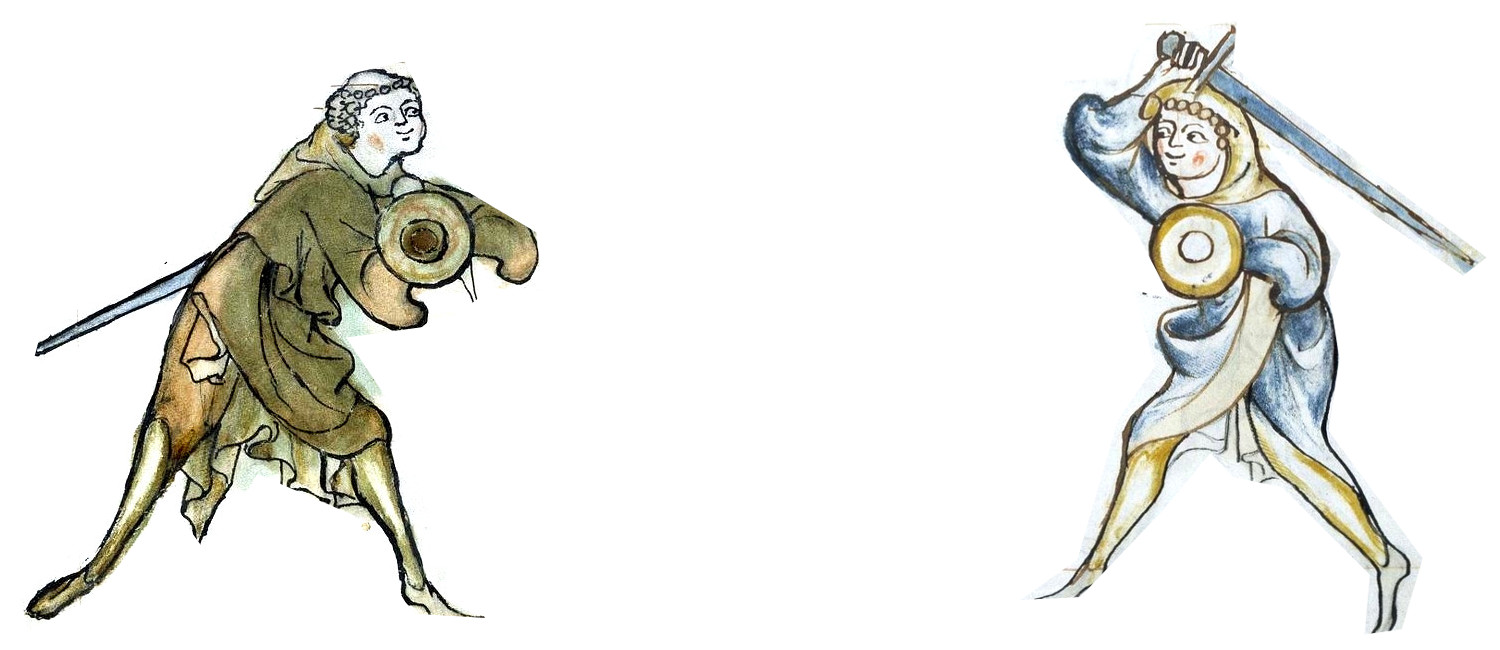
How much time - approximately - would such an attack from the distance take? We can reference a graph of reach vs. time (analyzed for longsword cuts, don't expect dramatic differences) and find that at extreme range when the whole body has to be moved forward, some 700+ ms can be expected. This is plenty of time for Ludger to react (human reaction time averages 250 ms), so his best answer to a direct attack would be a diagonal upward cut against Walpurgis' blade to clear the center line, followed by an attack against her head.

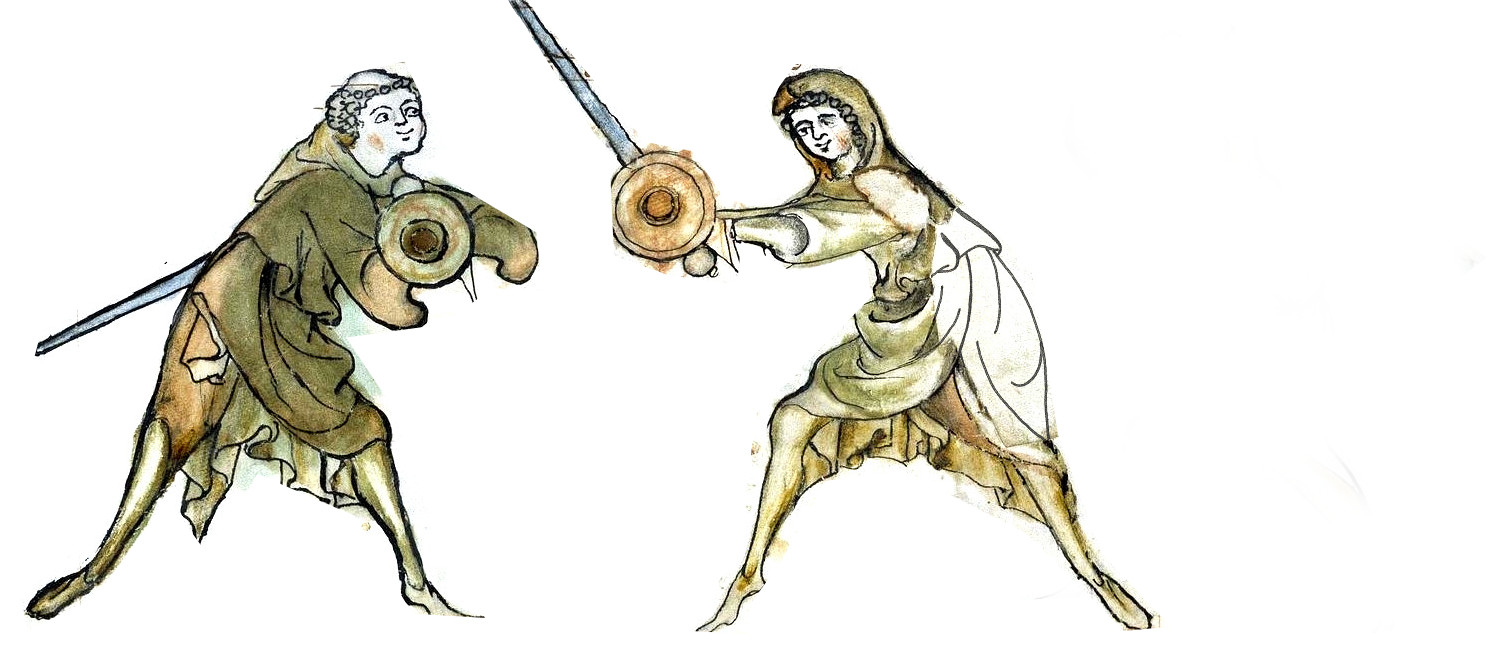
The whole motion doesn't need to be fast or threatening, so it takes her some at least 700+ ms. Again Ludger has sufficient time to think and react, but suppose he does not (as in the picture): Walpurgis now stands at a distance where she can lean an cut or do a minimal step and cut - actions that require just about 250 ms. Unless Ludger is super-humanly fast, he cannot prevent being hit on the head any more. So, the threat Walpurgis is making here is that as she moves forward, she can assume a position from which she can strike Ludger's head with near-certainty of success - if Ludger wants to avoid that, he needs to react. He could for instance step back, trying to re-establish a safe distance. Or he could move his blade to bind, so that when Walpurgis strikes, it is already in place for a block (this is what the manuscript advises). In fact, he could do a host of other things which are not discussed in the I.33 at all - the tactical threat just requires him to do something, it doesn't force him to do any particular action. (To be clear, once Walpurgis stands as close as in the illustration, the game for Ludger is over - he needs to react already while she advances. However, she doesn't actually need to stand so close, she could stand in lunging distance, giving her some 300-350 ms of attack time - Ludger would still be well advised to bring his blade closer to hers.) The outcome described in the manual is the following - Ludger moves his sword to bind, Walpurgis keeps a little more distance and stands ready to attack with a step or lunge:
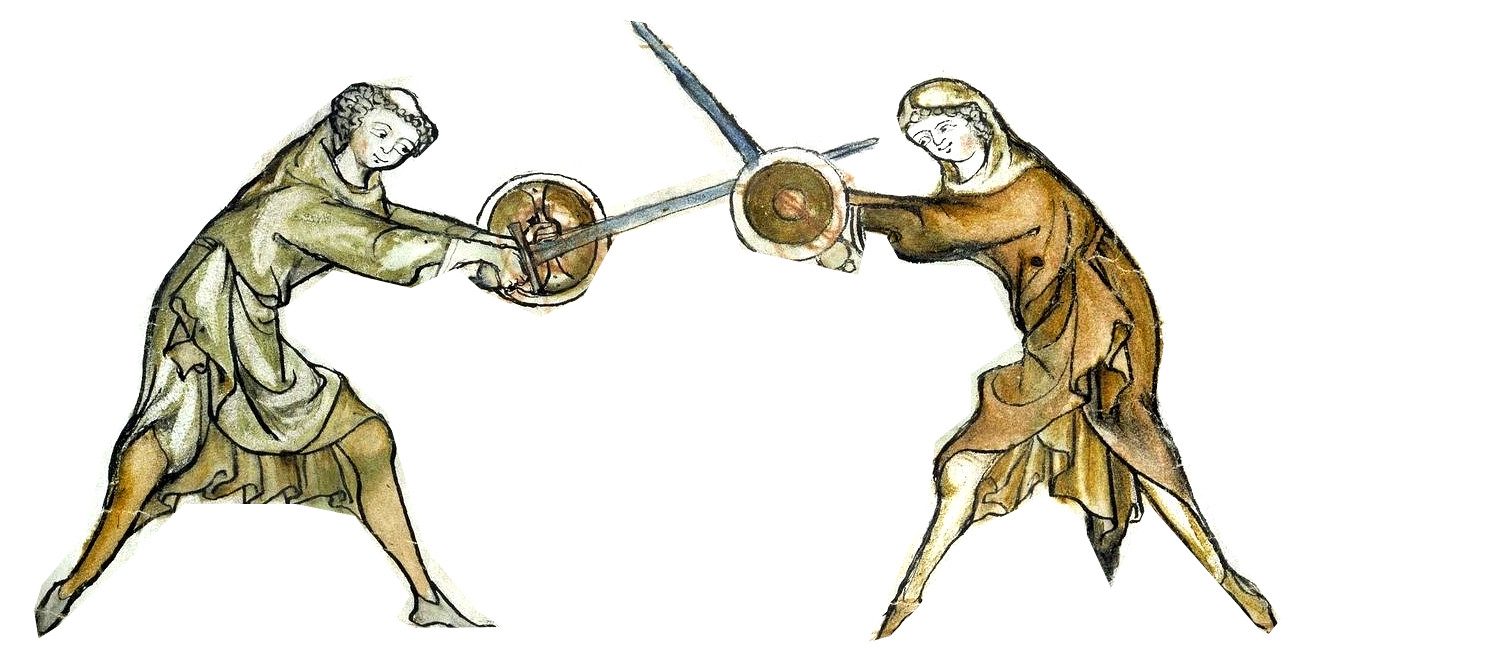
This, actually, seems the best outcome Ludger can get. Let's briefly go through a few other possibilities and see what Walpurgis would need to do.
And I counsel you with sensible advice that the one [with sword] under the arm should not do any cut (as recommends de Alkersleiben) for the reasons that he cannot attain the upper parts but if [he aims] lower it would be harmful to his head (1). Well, anyone who has ever sparred probably knows that opponent's don't reliably go for sensible advice - they might be reckless or ignorant of the danger. So let's not count out the possibility that Ludger is willing to take a head hit just to land his sword in Walpurgis. If he does, what she has to do is move her buckler to block the strike while cutting at his head. As a result, we see that if Walpurgis actually wants to make the threat work, she needs to be prepared for several less than optimal reactions from Ludger (or she invites a double-hit, which is never good fencing). This is what makes a tactical threat difficult to enforce if the opponent doesn't play along and reacts as would be 'sensible advice'.
Walpurgis threatens kruckeAfter the obsessio using halpscchilt and the plays resulting from it have been discussed, the I.33 proceeds to show a different obsessio Walpurgis could perform against the first guard - krucke. We may safely imagine that she does so from zufechten as above an takes some 700 ms to step forward, thus giving Ludger ample time to see what is happening and react accordingly.
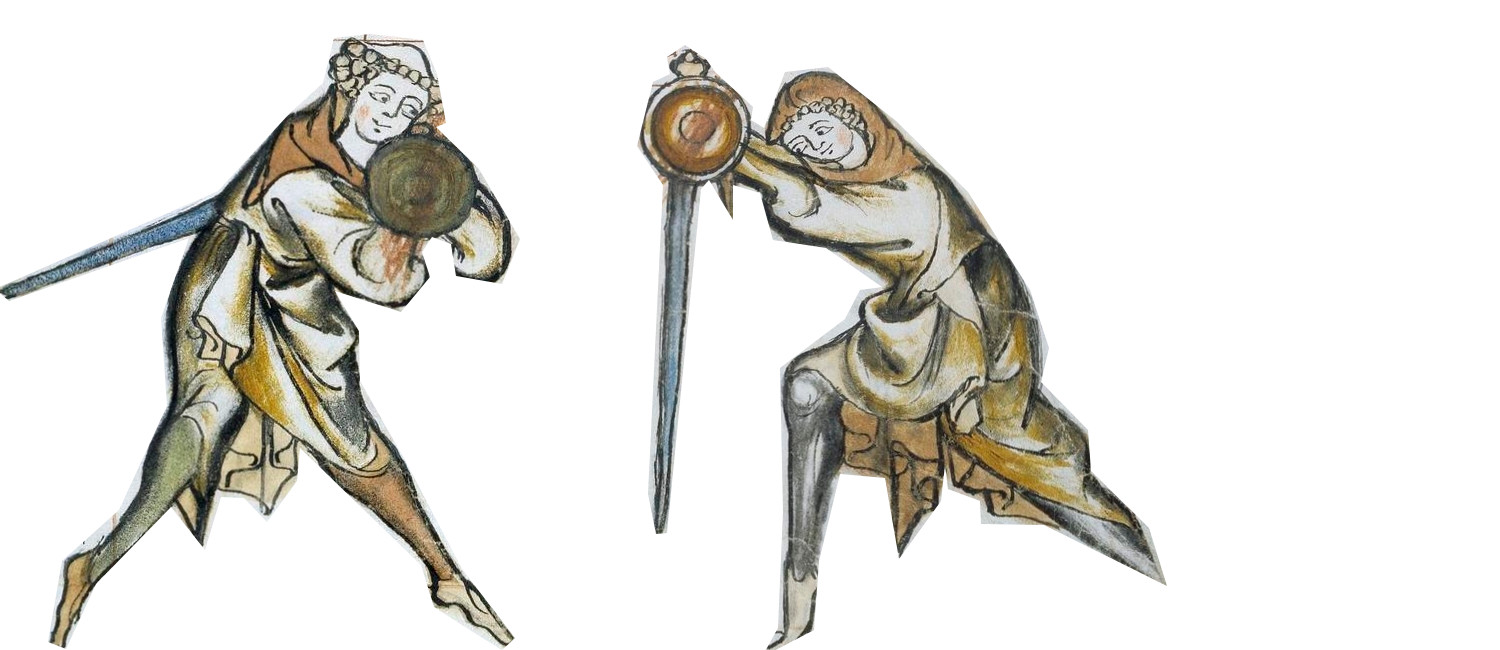
Here the nature of the threat is different, Walpurgis is not poised for an immediate attack - although the manuscript makes it clear when later Ludger is performing the same obsessio against Walpurgis on 5v, the 'or else' is identified as a subsequent thrust: Here the scholar has failed [to act] as he did not bind and the priest enters immediately and not without merit because whenever the one performing the guard fails to do what is his to do the one using obsessio must enter as shown here. (2) But the position depicted above isn't particularly good for quick thrusting. It serves another purpose - it blocks Ludger's main line of attack, i.e. the diagonal upward cut. Were Ludger to do the cut, he'd inevitably connect with her blade, bring his weak to her strong and give her a good opportunity for a counter-thrust (it's generally a bad idea to cut into the strong of a block). In particular, making the threat allows Walpurgis to approach quite close to Ludger - since she blocks the line, he cannot threaten her with a quick attack in return. Of course, as in the above example using halpschilt, Ludger could do any number of things. He could go back to gain more space, he could bind (this is what the I.33 suggests he should do) - or he could bring his sword before his buckler and then in an arc from above. The last option would be slow to do, but clearly give him a tactical advantage. It is possibly for that reason that the manuscript urges Walpurgis not to tarry: It must be known that the one doing obsession may not hesitate but needs to do a stich (i.e. thrust) quickly after his approach - then the opponent cannot think about what he should do (3) The timing is crucial and the time window is narrow - if Walpurgis is too eager and does a minimal block before launching into a thrust, Ludger will fail to see the block and hence the threat will not accomplish its purpose (to prevent Ludger from doing a diagonal upward cut) - Ludgers cut will displace the thrust and Ludger will have the upper hand. If, on the other hand, Walpurgis hesitates for too long in the block, Ludger will have the time to figure out a good counter. This is one of the reasons tactical threats are no technique for beginners.
Static vs. dynamical line closingOn 12r, Walpurgis performs another obsessio, this time against the theird guard (sword over the left shoulder). It's fairly clear that this works akin to the krucke discussed above - she advances in the cover of a static block that closes Ludger's line:
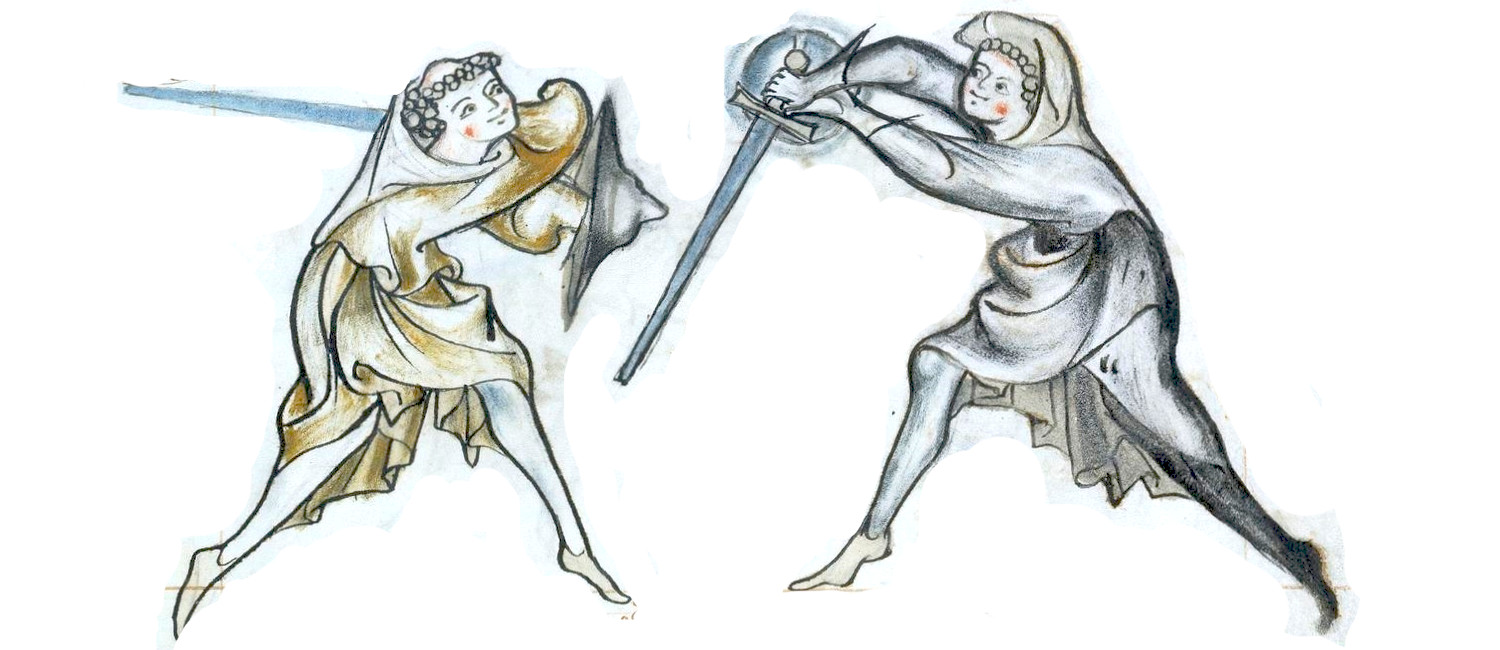
However, on 15r, the first guard is done by Walpurgis and described as obsessio valid against the fourth guard (sword over the head):
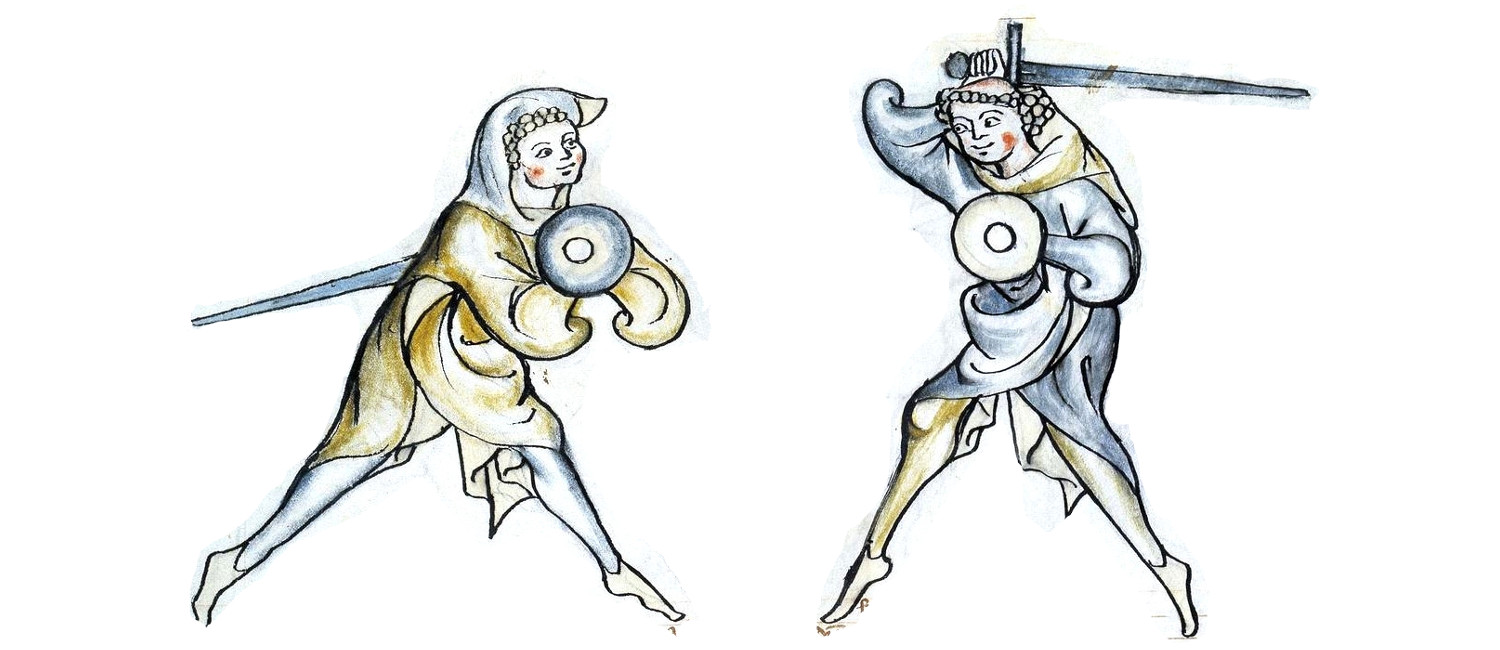
On first glance, it looks like she doesn't block his line of attack at all - Ludger can strike at her head at will. Yet if he does, she can defend with a diagonal upward cut against his blade and have the upper hand. So in actual reality, she is closing his line of attack, but not with an actual block but rather with a potential cut. (Contrary to how the illustration shows the distance between both fencers, I think it unlikely that using the threat of a dynamic cut she can get as close to her opponent as with a static block). The effect is the same in both situations - Ludger cannot attack in a straightforward way from his guard, Walpurgis is getting closer and he faces an attack from her side, so he has to act in some way.
What do tactical threats accomplish?We've seen that tactical threats come in a number of flavours - they can be positions from which a quick attack is possible or they can close the line for an attack from a guard (both statically and dynamically). But what do they accomplish?In the context of the I.33, they mainly allow a fencer to advance into measure and usually start a bind game. Advancing isn't as easy as it sounds, because a direct attack can run into so many counters that using a direct attack to advance could be considered a tactical mistake (The Fiore manual is full of advice what to do with enthusiastic swordsmen who go ahead and just attack). Even a well-thought feint based on an immediate threat might fail because the opponent doesn't grasp the threat in time and produces a double-hit. The relatively slow timescale of a tactical threat minimizes the chance that the opponent acts in completely unexpected ways out of a knee-jerk reaction. In a broader context, tactical threats challenge the opponent. He is forced to react to the threat, and that gives him the opportunity to make mistakes. Even if he reacts correctly, what he has to do might bring him out of his comfort zone. The I.33 is rather explicit about not every threat being of the same value - langort for instance gets branded as this is the obsessio of common fencers (4). A tactical threat is more of value if it confuses the opponent because he doesn't know all the implications and variants offhand. On the other hand, tactical threats chiefly work against opponents who understand tactics. If the idea of the opponent is to just come forward and do a series of cuts, it's more efficient to let him come and do a counter - if the opponent reacts with violent defensive motions to a small threat, just feinting is more efficient. If making a tactical threat leads to having to fend off an opponent who makes a suicidal attempt at double-hits, he clearly is not the right recipient for the concept.
Tactical threats in longsword fencingGiven that obsessio is such a central concept in the I.33, it is curious that tactical threats are near-absent in later longsword fencing manuals.I believe the reason is twofold:
SummaryThe concept of obsessio is central in the I.33 as a means to attack each particular guard with the right approach. An analysis of the sequences with variants - both as described in the text as well as logically implied - shows that the term clearly denotes a tactical-level threat, i.e. an action to which the opponent needs to respond, but in a calculated way. Often the manuscript shows the 'or else' (i.e. if the opponent does not react) explicitly and mentions variants and complications obliquely and in passing.Tactical threats serve the purpose of letting a fencer safely advance from zufechten into fencing measure. As such, they rely on good timing - long enough to let the opponent realize what is threatened, short enough to not let him execute a superior counter. The word obsessio literally means 'sitting upon' - an apt metaphor for the constraints on the possibilities for action which the technique brings.
Original quotes (English translations above by myself): (1) Et consulo sano consilio quod il[...] sub brachio non ducat aliquam plagam quod probat de al[b]ersleiben, per raciones quia partem superiorem attingere non potest si inferiorem capiti erit perniciosum (2) Hic obmisit scolaris quod non ligauit prossus sacerdos intrauit & non inmerito quia vbicumque regens custodiam obmittit quod suum est facere obsessor statim debet intrare vt hic (3) Sciendum quod obsessor non debet h[esitare sed] ducat statim stich post obsess[ionem ...] tunc non potest adversarius delibe[rare quod] intendat (4) est generalis obsessio
Liber de Arte Dimicatoria on Wiktenauer Back to main index Back to Swordfighting Created by Thorsten Renk 2025 - see the disclaimer, privacy statement and contact information. |