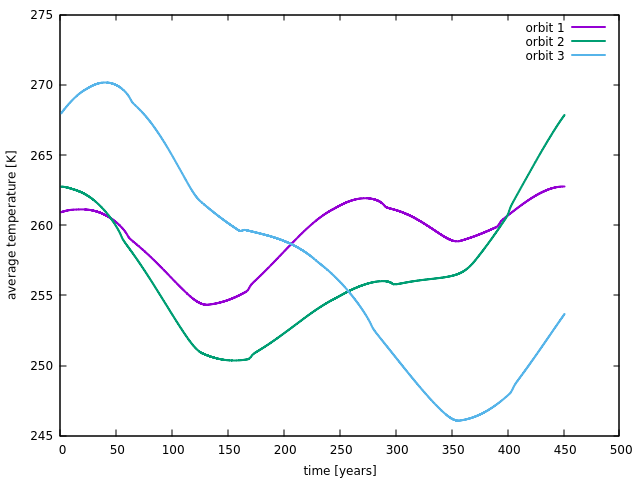
Lagrange orbit irradiationIrradiation and hence also seasons on a Lagrange orbit differ from both the Janus and the Helliconia type systems. In a Janus-type system, the stars are close in the sky and seasons work like with a single star - one hemisphere of the planet can be tilted towards the stars and experience summer, the other winter.During a Helliconia short year, the situation can change from a hemisphere being tilted towards both stars and experiencing extreme summer to each hemisphere facing one star and thus, dependent on the radiation budget, mild summers and winters. On a Lagrange orbit, the angular distance between the stars is fixed but large - the axial tilt can never align such that a hemisphere faces both stars and seasons are dominated by how the planetary rotation axis aligns with the more luminour star. On top of that, as we've seen in the last section, a slight eccentricity of the orbit can drive a complicated irregular orbit of the planet around the Lagrange point. This in turn leads to distance variations to the stars which translate into irregularly varying temperature patterns. For Emerald with a relatively small 15 deg axis tilt, this is the main cause of seasons. The average temperature of the planet experiences irregular 20 K variations from orbit to orbit.
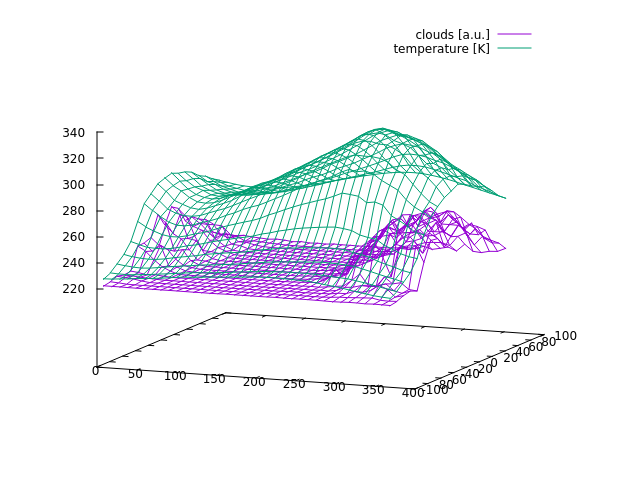
Clouds and weatherIn example33.cfg, Emerald is given a thin, CO2 rich atmosphere and weather patterns to study viability as a life-bearing world.The 42 h rotation period of Emerald is slow, and so direct convection transports heat. The main weather pattern is the strong build-up of convective clouds and thunderstorms in the early phase of the day. Once the energy dissipates and the sky becomes clear, temperatures reach a peak and then slowly sink again as Sapphire moves towards the horizon and only Ruby keeps the warmth. Even near the equator, the long night means that temperatures can be below freezing point and winters near the pole tend to be chilly and constantly below freezing.
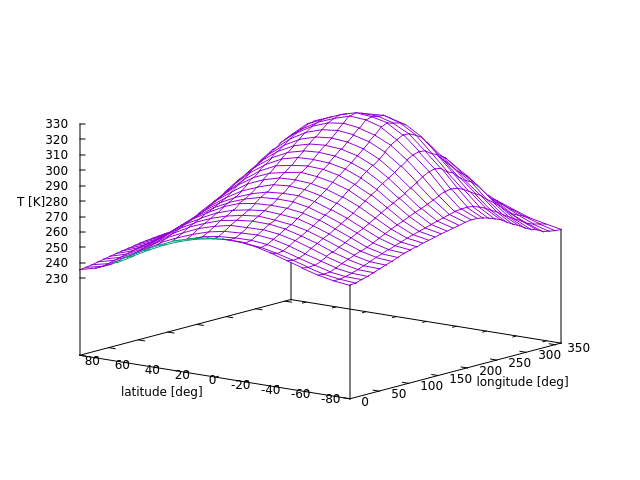
SeasonsSince the orbital period of Emerald is 450 years, seasons last very long which means that the winter hemisphere is in darkness and cool for decades.During the hottest season at the beginning of orbit 3, the axis is aligned perpendicular to Sapphire, so both hemispheres are heated. Maximal temperatures reach up to 330 K, while chilly 240 K are found in polar winter. Even then, for a short time just before dawn, the equatorial temperature reaches below freezing point due to the long night.
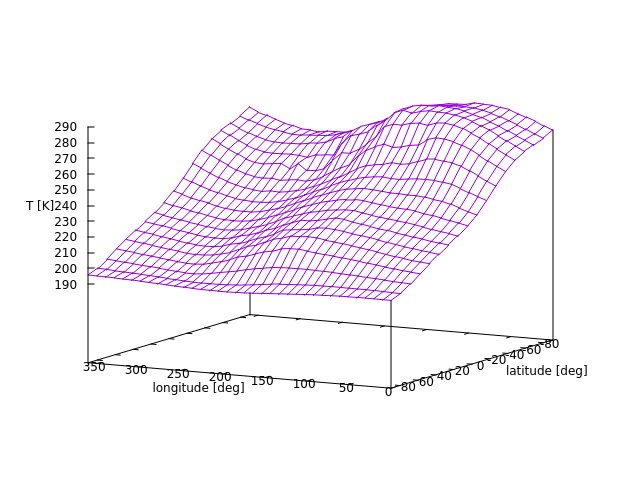
During a cold period 150 years into orbit 2, the south pole of Emerald experiences summer and day temperatures above freezing, but most parts of the planet are cold with temperatures reaching all the way down to 200 K near the north pole. With near certainty, an ice age would dominate dynamics during this phase of the orbit.
Conditions on Emerald are thus characterized by strong and non-periodic seasonal variations as well as hard contrasts between daytime and nighttime temperatures - all in all a challenging environment for the development of higher life.
Back to main index Back to science Back to worldbuilder Created by Thorsten Renk 2026 - see the disclaimer, privacy statement and contact information. |